Korona di Hesus - An Invasion that has laster already for 140 years
(Published in the newspaper Amigoe on the 23rd of September 2026)
Korona di Hesus
An invasive species does not have to spread at lightning speed. This is proven by Korona di Hesus, the thorny tree with the scientific name Balanites aegyptiaca. It was planted on Curaçao almost a century and a half ago and has been expanding its area slowly but almost continuously ever since.
That is very different from, for example, the neem. That tree probably only came to Curaçao a few decades ago and is now popping up in all kinds of new places at a rapid pace. Korona di Hesus takes his time. But slow doesn't mean harmless.
An African tree on Curaçao
Balanites aegyptiaca is native to Africa and parts of the Middle East. In Africa, it covers almost the entire Sahel region, from Senegal in the west to the Nile Valley and Egypt in the northeast, and south to Zambia. In the Middle East, it covers the Arabian Peninsula and areas from Syria to Yemen. It is a tree that is excellently adapted to dry conditions. Curaçao is emphatically one of the places where the species has been introduced by humans.
That immediately explains why Korona di Hesus can feel at home here. The tree can withstand heat and long periods of drought. It grows in its original habitat under conditions that are very similar to those of Curaçao in some respects.
It usually does not become a huge tree. A height of six to ten meters is normal. The branches bear sturdy, straight and sharp thorns. A very easy point of recognition are the leaves: each leaf consists of two sturdy, oval-like leaves.
Korona di Hesus has small, yellow-green flowers, in short clusters in the leaf axils. The flowers usually have five petals. And then there are the fruits that are up to 4 centimeters long. The fruits are green at first and turn yellow-brown when ripening. They somewhat resemble small dates. Hence the English name desert date. They are also edible but bitter. Inside is a very hard kernel with an oily seed.
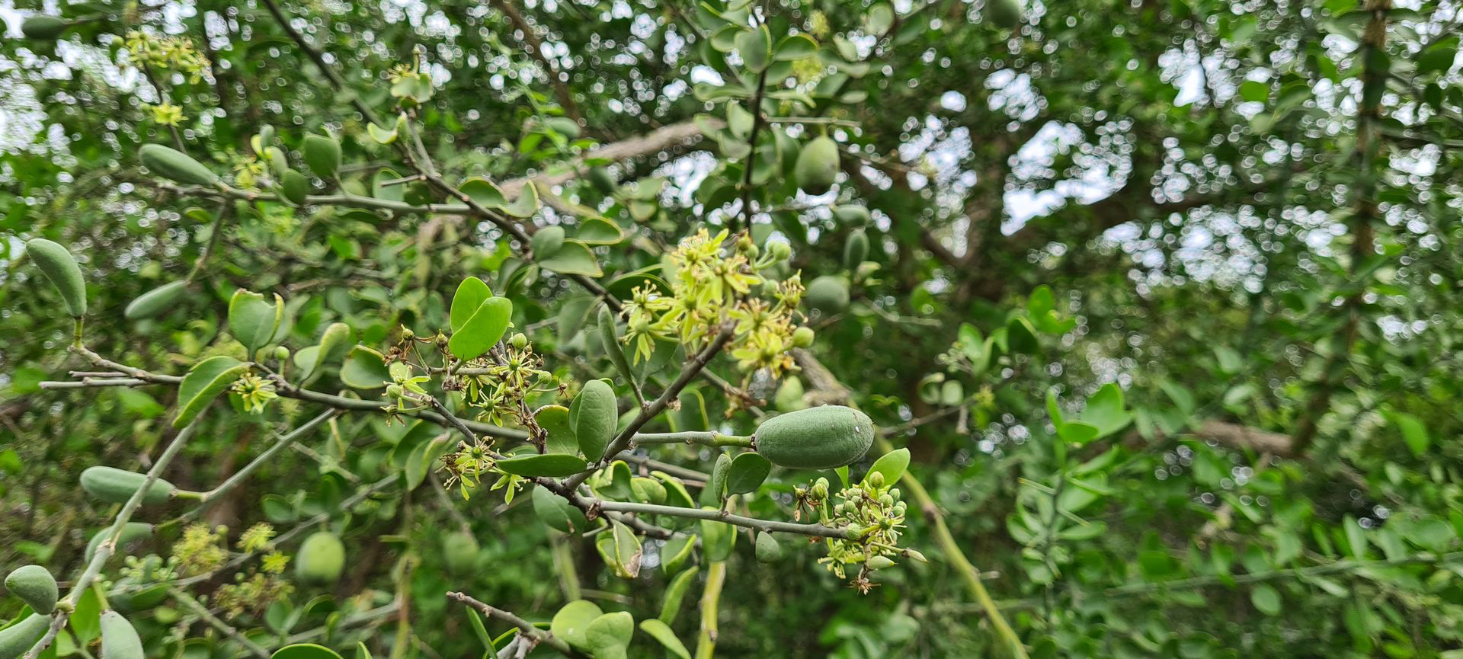
Flowers and fruits of Korona di Hesus (Photo: John de Freitas)
We even know who brought it
For many invasive plants on Curaçao, their first arrival is shrouded in mystery. With Korona di Hesus it is different. According to the Curaçao plant expert Frater Arnoldo, the tree was planted in 1885 by C. Gorsira at Plantation House Arrarat. Cornelis Gorsira (1848 – 1924), also known as Shon Nene, was born at Plantation House Ararat. He was a very well-read man and a meritorious painter. In 1874 he discovered phosphate on Table Mountain.
The exploitation of phosphate on Table Mountain in Curaçao in the late nineteenth century came about through a collaboration between the local landowner Cornelis Gorsira and the foreign mining entrepreneur John Godden. To exploit the phosphate, the Curaçaosche Phosphaat Maatschappij was founded. The income from this company enabled Cornelis Gorsira to travel. He visited Egypt, then Palestine and traveled in the mountains of Gilead (now Jordan). From these areas he brought seeds of the Korona di Hesus, the Apeldam and the Doum palm to Curaçao in 1882. These trees have in common that they have edible fruits. Perhaps this played a role in his decision to take the seeds of these trees to Curaçao.
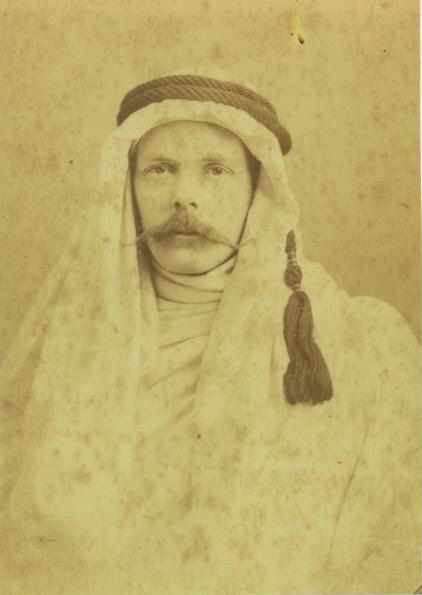 Cornelis Gorsira
Subsequently, the trees were planted on Curaçao property belonging to the Gorsira family, or related families, such as Ararat, Zuurzak, St. Michiel, Malpais and St. Joris. Thus began an invasion that continues to this day. The species has now even been found at Knip in Banda Bou.
Why Korona di Hesus?
The name literally means Crown of Jesus. Anyone who looks closely at a branch of the tree will understand why. The straight, long and hard thorns are reminiscent of the crown of thorns from the Biblical story of the crucifixion of Jesus. There is also another Curaçao name for the tree: lamunchi shimaron, wild lime. Both names are mentioned in botanical sources for Curaçao.
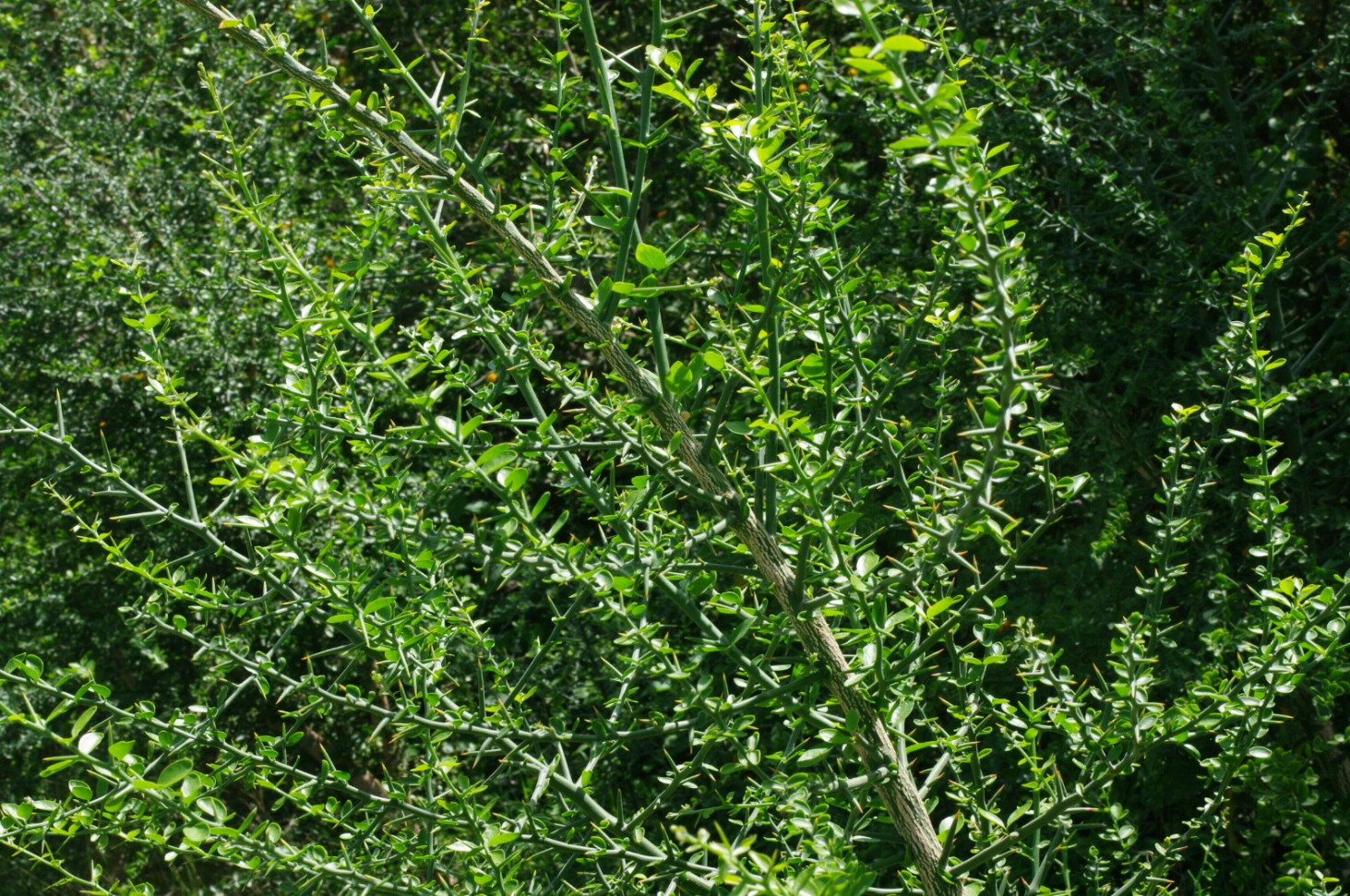
Korona di Hesus (Photo: Carel de Haseth)
A fruit made for travel
To understand how Korona di Hesus spreads, we must go back to those yellow-brown fruits. The flesh is edible. In Africa, the fruits are eaten by people, but all kinds of animals are also interested in them. The hard pit can end up somewhere else after eating the fruit. That is an excellent way for the tree to travel. Scientific descriptions state that the seeds are spread by birds and other animals. On Curaçao, the seeds are mainly spread by goats.
The tree usually only starts producing flowers and fruits after five to seven years. The greatest seed production is achieved when trees are fifteen to twenty-five years old. That may also help explain why the advance is not so explosive. A young neem produces offspring very quickly. With Balanites, the cycle is much slower.
In addition, the seed is locked in an exceptionally hard kernel. Research into germination shows that damage to that hard exterior can greatly improve germination. An animal that eats a fruit and transports the pit can therefore play an important role in the creation of a new tree.
Why is it a problem?
Korona di Hesus is not just an exotic tree that happens to be in the mondi. Curaçao sources consider him invasive. The tree has since become wild and has continued to expand its range. He has changed landscapes. His strength is perseverance. An adult Korona di Hesus is excellently adapted to drought. It can remain in places where other trees are struggling, produces fruit for years and thus gets new opportunities to spread further. An invasion in slow motion.
Not everything on the tree is bad
As with many invasive species, it is important to distinguish between a harmful species and a worthless species. Korona di Hesus is a particularly useful tree in its original habitat. The flesh is eaten. Oil can be extracted from the seeds. Leaves and fruits serve as food for animals and the hard wood can be used for charcoal, among other things.
The tree has also been used in traditional medicine for a very long time. Several parts contain biologically active substances, including saponins. Scientific research is being done into possible medicinal uses, although that does not mean that such traditional uses are automatically proven or safe. So again, the problem is not the tree itself. The problem is where we put it.
An invasion of 140 years
The story of Korona di Hesus is perhaps one of the finest examples of why we should be careful with plants we bring to an island. In 1885, someone planted a special tree on Curaçao. Probably no one could predict at the time what the result would be. Forty years later, there were more. Eighty years later, the tree had moved further west.
And about 140 years after the first planting, the spread continues. Let's see how fast an invasive tree can advance. Korona di Hesus teaches us perhaps something even more important. An invasive species does not have to be in a hurry at all. If he gains only a small piece of ground every year and hardly ever disappears, he will eventually only need time.