Buttonwood
(Published in the newspaper Amigoe on the 8th of October 2025)
Buttonwood trees are usually found in the area between the tidal zone and the mainland. Even though it’s not a true mangrove, it’s often found near mangrove communities. We call these trees mangrove companions.
Name
The buttonwood tree gets its name from the button-like shape of its dense flower heads, which grow in clusters and form cone-like fruits. Its scientific name is Conocarpus erectus. This name comes from the Greek words “kônos” (cone) and “karpus” (fruit). In Papiamento, we call this tree the “mangel blanku.” This name can be a bit confusing because there’s also the white mangrove we talked about in the previous article. But the white mangrove is a different species altogether.
Manner of growth
Buttonwood trees can stay small and bushy, but they can also grow up to 66 feet tall! Unlike the red mangrove, which has perfectly formed plants in pods, the knot mangrove makes seed pods. Unlike the other three mangrove species, the knot mangrove’s leaves grow in pairs instead of opposite each other. They’re leathery with pointed tips and smooth edges. The flowers look like cones and are green. There is also a variant of buttonwood with silver-colored leaves.
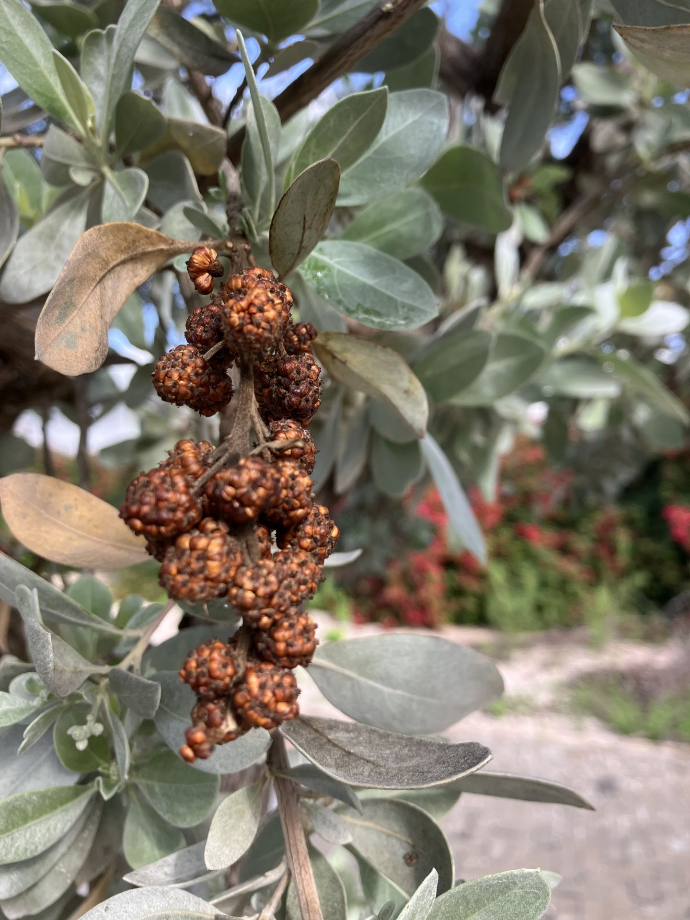
Seed pods silver buttonwood
Each leaf has two special glands that make sweet sugar. These sugar glands are like little factories that make sugar to attract ants. The ants are like tree guards, and they protect the tree from being eaten by hungry leaf-eaters and other pests. This protection works in the white mangrove too. In general, this protection mechanism occurs in trees in nutrient-poor soils that slowly recover from being eaten by leaf-eating organisms. Because the leaves have a higher value they need protection.
Stability
Buttonwood doesn’t grow in the muddy tidal area. It usually grows in regular soil, so it doesn’t need special roots to stay stable. That’s why Buttonwood has a regular root system.
Salt resistance
Buttonwood limits the amount of salt that enters through the roots. Their root cells act as a selective barrier, allowing water to enter but keeping most of the salt out. This is a passive exclusion process that is less effective than the mechanisms in some other mangroves, but still important.
But guess what? Even though the plant tries to get rid of the salt, some still comes in. When that happens, the plant stores the salt in older leaves. These leaves eventually die and fall off, which helps the plant get rid of the extra salt over time. The red mangrove has a similar way of getting rid of the salt.
Buttonwood is also used for landscaping. Buttonwood is especially suitable for soils in which salt occurs near the sea. For example, it is planted along the road to Carmabi on the south coast.
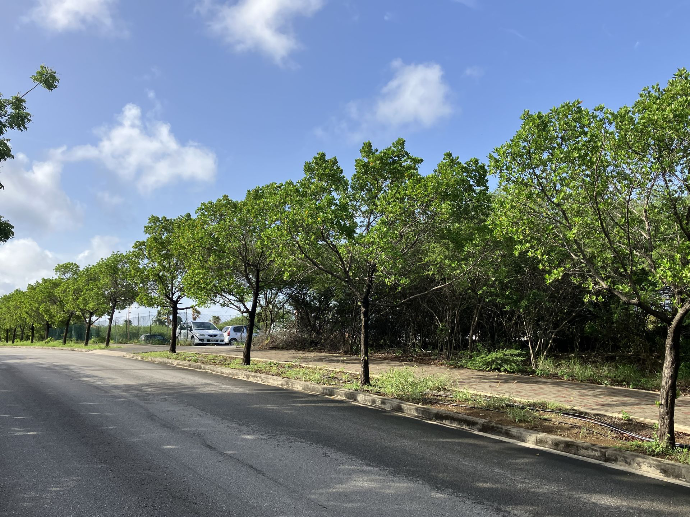
Buttonwood along road to Carmabi
The silver-colored variant is also widely used for landscaping. In Latin, the silver-colored variant is called “Conocarpus erectus var. sericeus”. In English it is called “Silver Buttonwood”. This variant is also suitable for plantings near the sea in soils with salt. For example, it was used on the road opposite Harbor Village near Carmabi.
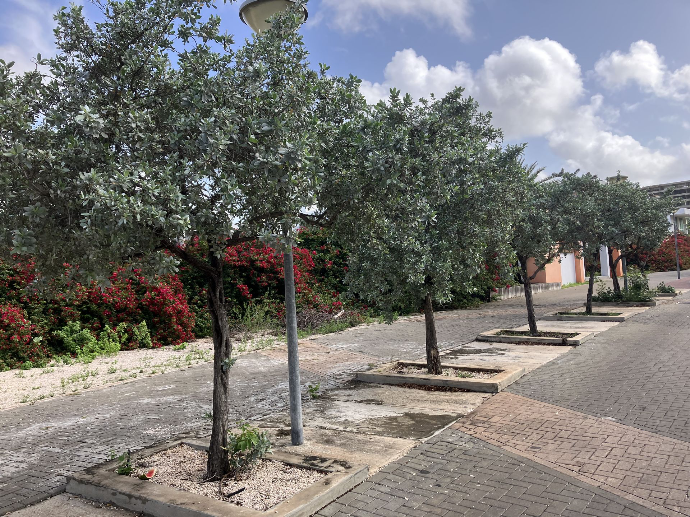
Row of silver buttonwood next to harbor village at Piscadera
Respiration of the roots
In ordinary soil, there is a lot of air in the pores between the soil particles. Buttonwood does not grow in the mud but in a normal soil with pores with air. It needs therefore no special mechanisms to supply the roots with air.
This article discusses buttonwood in detail. This is also the last of the four Curaçao mangroves. In the following article, we discuss the importance of the mangrove for the protection of land and sea. Because the mangrove grows between land and sea, it is able to protect both land and sea. This makes the mangrove unique and very valuable!