Hasmin - The Climbing Plant that Packs Trees
Published in the newspaper Amigoe on the 21st of October 2026
When you hear the name Hasmin, you may think of an innocent jasmine with wonderfully fragrant white flowers. And indeed: the small white flowers of this plant smell pleasant. But the Hasmin in question here, Jasminum fluminense, also has another side.
It is a vigorous climbing plant that can overgrow shrubs and trees. He does not originally belong in Curaçao. The plant comes from Africa and parts of the Arabian Peninsula and has been brought by humans to all kinds of tropical areas. Once in a new place, Hasmin can spread independently. The plant makes fruits that are eaten by animals, grows quickly through other vegetation and can eventually form a dense package of stems and leaves. This makes Hasmin another example of a plant that probably once came to Curaçao with good intentions, but then did not stick to the boundaries of the garden.
A jasmine from Africa
Its scientific name is Jasminum fluminense. The species belongs to the olive family, the same plant family that also includes other jasmines and the olive tree. However, according to the botanical database of Kew Royal Botanical Gardens, its natural range is in tropical and southern Africa and parts of the Arabian Peninsula. The species is native to Angola, Kenya, Mozambique, Tanzania, Nigeria, Zambia and Zimbabwe, among other places. From its original habitat, Hasmin was brought by humans to other warm parts of the world. Today, it is found as an introduced species in large parts of the Caribbean, Central America, parts of South America and on several islands in the Pacific Ocean. The former Netherlands Antilles are also on that list.
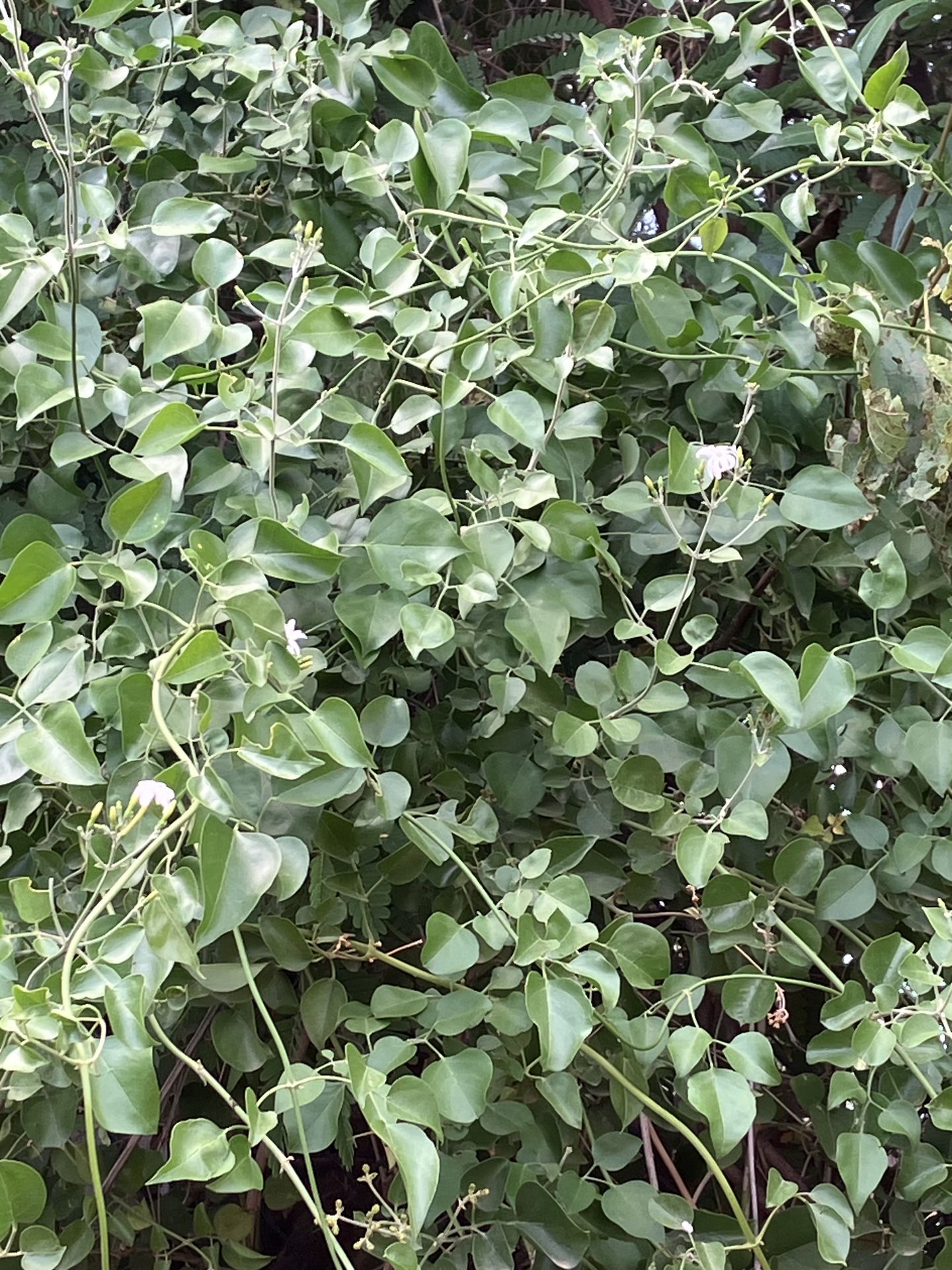
Hasmin on a fence in the Savaan
On Curaçao for more than a hundred years
When the first Hasmin came to Curaçao and who took him with him is difficult to determine. We do know that it is not a recent newcomer. The Dutch botanist Isaac Boldingh already mentioned the plant in his botanical works on the Dutch West Indies islands from 1909 and 1913. Why he was brought here cannot be said with certainty. But everything points to the most obvious explanation: as an ornamental plant. This also happened elsewhere in the world. The plant has attractive fragrant white flowers, grows easily and can be led over a fence, pergola or other support.
First a garden plant, then a wild plant
The problem with a climbing plant is that it doesn't know where a garden ends. Hasmin is a woody climbing plant. The young stems are thin and supple, but older stems become increasingly sturdy. The plant uses other vegetation as support and works its way up.
In Florida, where Jasminum fluminense has also been introduced and has become invasive, Hasmin has been observed to climb high into mature trees. The plant can completely cover the original vegetation there. That is exactly why a climbing plant can be a special kind of invasive plant. A tree has to invest for years to grow tall. It makes a trunk, branches and roots to eventually bring its crown to the sunlight. Hasmin doesn't have to do any of that. He just uses the tree.
A blanket over the mondi
This makes Hasmin somewhat similar to Palu di Lechi. Both are climbing plants that other plants use as support. When Hasmin grows through a bush or tree, more and more of its own leaves will lie on top of the leaves of the host plant. As a result, it intercepts sunlight.
For a plant light is food. With the help of sunlight, green leaves make sugars that allow the plant to grow and stay alive. When a shrub disappears further and further under a dense package of climbing plants, this becomes more difficult. In addition, the climbing plant forms an extra weight on branches and twigs. In areas where Hasmin has become highly invasive, the plant can eventually overgrow entire areas of vegetation.
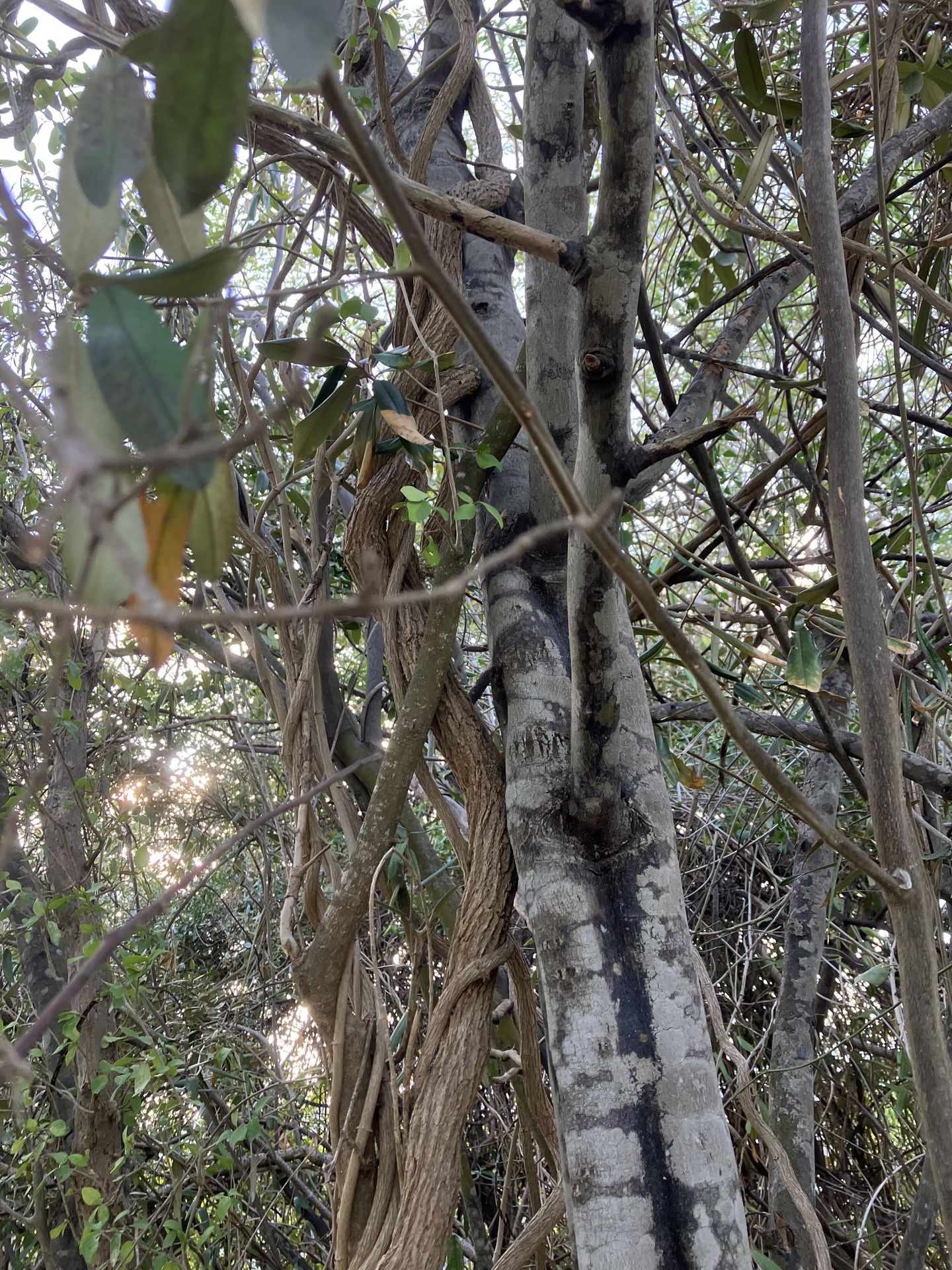
Hasmin climbs an Oliba at Rooi Catootje
On Curaçao especially where the conditions are favorable
Hasmin does not seem to be equally successful everywhere in Curaçao. A study of invasive plants in the Dutch Caribbean describes Jasminum fluminense as a species that is mainly found in natural vegetation in more humid places where the soil is relatively well developed.
That's interesting. After all, Curaçao is a dry island. Many of our original plants specialize in surviving with little water and thin, rocky soil. So Hasmin does not have the same opportunities everywhere. But Curaçao is also not equally dry everywhere. There are dry gullies , low-lying areas and other places where water collects after rain. There are also areas with deeper soils that retain moisture for longer. In such places, a plant that needs a little more moisture can suddenly gain an advantage. This helps explain why invasive plants are sometimes a major problem very locally.
The birds help
Hasmin also has an excellent way to move from a garden or existing growing site to somewhere else. After the white flowers, small fleshy fruits arise. When ripe, they turn dark to almost black.
For birds and other animals, such fruits are food. The animal eats the fruit, but that is precisely where the journey begins for the plant. The seeds can be taken and placed in a different place. In Florida, spread by birds and mammals is a major reason for Hasmin's invasive power. The plant produces many seeds and they can also germinate very well. This means that Hasmin is not dependent on a gardener who takes a cutting. A bird can do the work.
One plant becomes a network
Hasmin doesn't just spread through seeds. The long stems grow through and over other plants and can form an intricate network. Once such vegetation is well developed, control becomes difficult. Just removing some leaves and tendrils is not enough. The plant should be traced back to the main stems and tackled there. In invasion control in Florida, it is also warned that an area must be rechecked after treatment. This is characteristic of many invasive plants. Removing the first is not the hardest part. The hardest part is making sure they don't come back.
Not every jasmine is Hasmin
There is something else important here. There are hundreds of varieties of jasmine and several of them are grown as ornamental plants. Not every plant that is called "jasmine" in Curaçao is automatically this invasive Hasmin. Jasminum fluminense is recognizable by its leaves, among other things. A leaf consists of three separate leaves. The middle leaf is usually larger than the other two. The white flowers are grouped together. They have a long narrow flower tube and at the end the petals spread out like a small white star. The flowers open especially at night and smell. Later, the small dark fruits appear.
An old intruder
Hasmin differs from neem in another interesting way. At take, we can almost see the invasion of Curaçao happening. That tree seems to have been introduced only a few decades ago and is now spreading further and further. Hasmin has been with us much longer. Already at the beginning of the twentieth century it was described by botanists on the Dutch Caribbean islands.
Beautiful is not the same as innocent
Hasmin probably didn't come to Curaçao either because someone wanted to change our nature. Probably the exact opposite happened. Someone saw an attractive climbing plant with beautiful, fragrant white flowers and thought: I want that in my garden. That happened all over the world. But a plant that is beautiful and useful in a garden can show very different properties outside that garden. Hasmin can climb, grow quickly, make a lot of seeds, and have those seeds spread by animals.
In its original habitat, these characteristics simply make it a successful plant. On an island where he doesn't belong, the same traits can make him an intruder.
In doing so, Hasmin again tells the same lesson as Palu di Lechi, Tumba Rabu, neem and Beyisima. The most dangerous invasive plant doesn't have to look dangerous at all. Sometimes it even smells delicious.