What are the Threats to the Mangrove Ecosystem
(Published in the newspaper Amigoe on the 5th of November 2025)
In our last article, we talked about how important mangroves are. You’d think that since they’re so important, they’d be protected and planted everywhere. But guess what? That’s not the case! Mangroves are in big trouble. That’s what we’re going to talk about in this article.
Infrastructure construction
Mangroves are often cut down to build stuff like jetties and marinas. Private folks build jetties to moor their boats, and companies build marinas. This is happening right now in the lagoon near Koredor in Rif. Mangroves are also disappearing because of houses and hotels. Building roads inland can change the direction of watercourses, which can mess up the water supply in mangrove areas. This can make the water too salty or not sufficient salty, or it can bring in too much or too little sediment. If there’s too much sediment, seedlings can get buried. If there’s too little sediment, the mangroves can’t keep up with the rising sea level. All this is bad for mangroves.
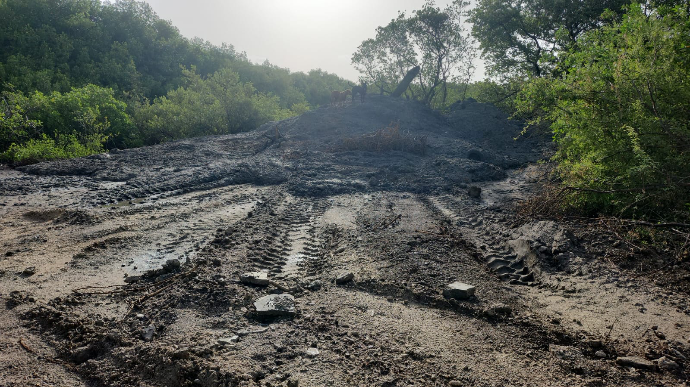
Destruction of mangroves (Credits Uniek Curaçao)
Overly simplistic ideas about compensation mechanisms for cutting down mangroves
When it comes to mangrove felling, people often say that we’ll plant more mangroves somewhere else to make up for the ones we cut down. But that’s not quite right! You can’t just plant 100 mangroves in one spot to make up for cutting down 100 mangroves in another. The good things mangroves do are often specific to where they are. If you cut down mangroves in one place, the coral reef will suffer, the nursery chamber there will stop working, and the coast will be less protected. So, even if you plant lots of mangroves somewhere else, you’ll still have problems where you cut them down.
Lack of legal protection
Mangroves in Curaçao aren’t protected by law, which is a bit puzzling since they offer so many benefits to the island. If big projects get an Environmental Impact Assessment (EIA), it could also protect the mangroves. But Curaçao doesn’t have a legal requirement for an EIA. Many other countries do, though. An EIA looks at the social benefits and costs of a development, making sure everything’s balanced. If mangroves were cut down, the social costs would be considered too. But that’s not happening right now.
The cumulative effect
Imagine this: during construction, some mangroves are cut down. Someone sues the company. The court decides that cutting down a few mangroves doesn’t make a big difference because there are still plenty left. But here’s the catch: the court only looks at the case presented to them. They don’t consider the long-term impact, like how much nature is being destroyed overall. On Curaçao, construction is happening all the time, and even small amounts of destruction add up quickly. This is how nature is disappearing, and policymakers and judges need to be aware of this cumulative effect. Otherwise, we’ll lose most of our mangroves and nature in general.
Rising sea levels
Mangroves live in shallow coastal waters, so their roots stick out of the water to breathe. In the previous articles, we saw that the black mangrove breathes through its pneumatophores, which are like snorkels that stick out of the water. But if the water gets too high, the roots go too deep, and the trees don’t get enough oxygen and die. In theory, mangroves could move to higher land, but often, that land is used for buildings, farming, or other human activities, leaving mangroves stuck between rising water and human barriers. This is called the “coastal squeeze.” Higher sea levels also make the water saltier further inland. Some types of mangroves and young plants can’t handle too salty water, which makes it harder for them to grow or survive.
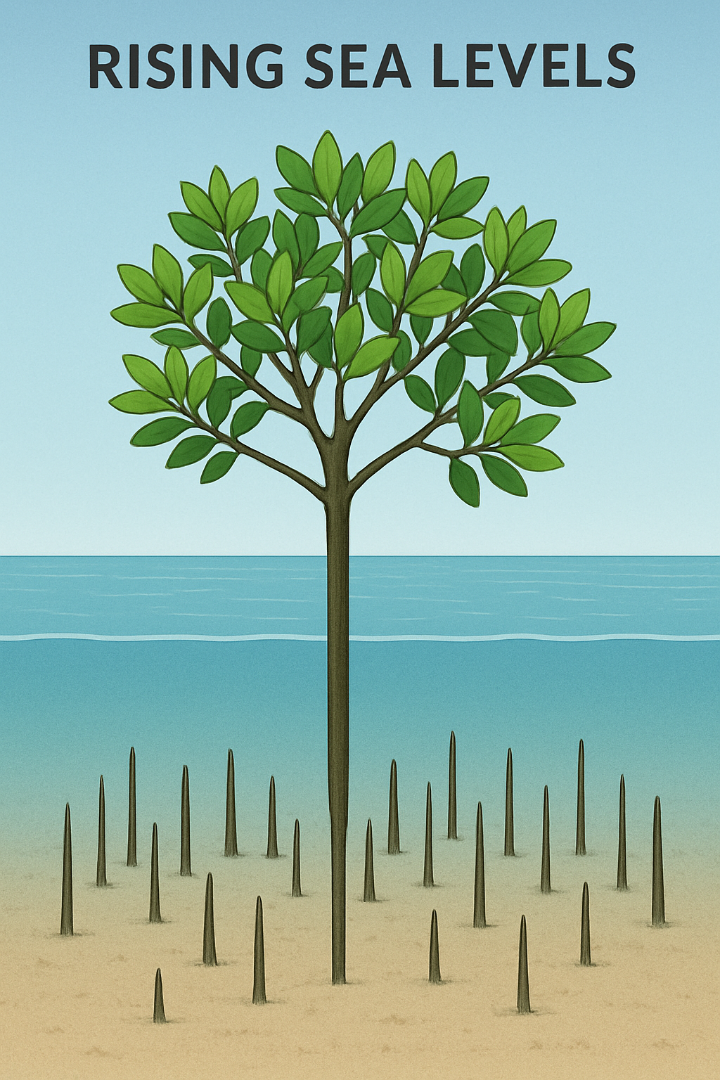
Sea level rise affecting mangroves
Higher air temperatures
The burning of fossil fuels and other human activities are causing the Earth to warm up. Air temperatures are rising, and even though mangroves are tropical plants that can handle heat, extreme and long-lasting temperature increases can hurt their growth, reproduction, and survival. When temperatures get too high, mangroves can’t make as much food through photosynthesis, especially if it’s also dry or salty. Higher temperatures can also mess up when mangroves make seeds, which can affect how they naturally grow back. Higher temperatures can also spread pests and diseases. Heat makes more water evaporate, which leads to saltier soil and more salt stress for plants.
Loss of vegetation behind mangrove areas
If you clear the vegetation behind a mangrove area, more sediment will end up in the mangrove area. Seedlings can then be buried. Natural channels between the mangroves can also get clogged up. This is what happened to the mangroves at Lac on Bonaire. The natural channels in the mangrove area at Lac got clogged up because of overdevelopment and grazing of the vegetation behind the mangrove. The local foundation “Mangrove Maniacs” is working hard to open these channels again.
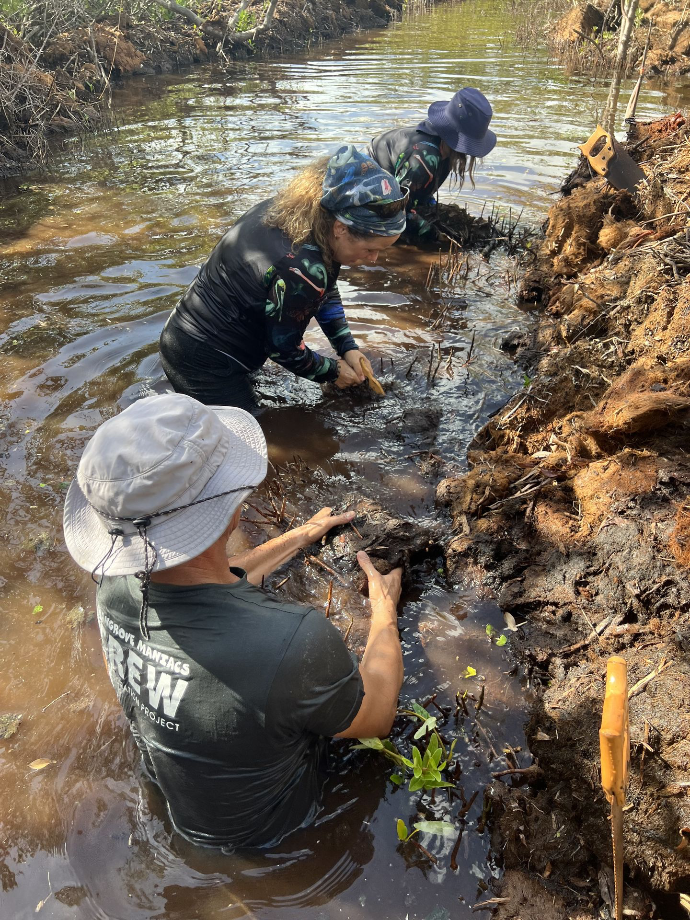
Opening up channels mangrove area Lac, Bonaire
Pollution
Mangroves are super sensitive to pollution, and certain pollutants can really mess with them. Oil can coat their roots and leaves, blocking the flow of oxygen. This can kill the trees. Heavy metals like mercury, lead, cadmium, and copper can be absorbed by the roots and poison the plants. Pesticides and herbicides, especially when they run off from farms, can be toxic to mangrove plants and the animals that live in the soil. Too many nutrients, like fertilizer and sewage, can cause algae to grow and take over the soil, leading to less oxygen. And microplastics can mess with mangroves in a bunch of different ways. Scientists are still learning about how microplastics affect mangrove ecosystems, but they’ve found that they can carry toxic substances and even get stuck around the roots of mangrove trees, making it hard for them to breathe.
In this article, we’ve given you a quick rundown of the threats facing mangroves. In the next one, we’ll dive into what we can do to protect the mangroves we have and what we can do to plant new ones.