The Importance of the Mangrove for the Protection of Land and Sea
(Published in the newspaper Amigoe on the 22nd of October 2025)
In the past five articles, we’ve covered the four types of mangroves found in Curaçao: red mangrove, black mangrove, white mangrove, and buttonwood. But why are mangroves so important? We’ll dive into that in this article!
Historical occurrence of Mangroves on Curacao
Back in the 17th century, Curacao had a lot more natural coastal and lagoon areas with healthy mangrove forests than it does now. The island’s lagoons and inlets, like the Spanish Water, the Rif area, Piscadera Bay, and other coastal spots, had huge mangrove zones. These mangrove forests were a big part of Curacao’s original coastal ecosystem. But sadly, many of these mangrove forests have gone away over time because of human activities.
Current mangrove areas in Curaçao
Guess what? Curaçao still has some mangrove areas! A report from 2013 by Carmabi revealed that Curaçao’s mangrove forests cover around 55 hectares, which is a tiny 0.12% of the island’s total area. These mangroves thrive in Piscadera Bay. Ryan de Jongh has also done some planting here. Near the Rifwater (a natural inland water near Otrobanda), you’ll find several mangrove species growing along the Koredor. The Rif Curaçao Mangrove Park is situated at the Megapier. The Spanish Water is one of the largest lagoon areas in Curaçao. You’ll find different types of mangroves here, but red mangroves are especially common. This area is a haven for birds, fish, and marine life. Many mangroves grow near St. Joris Bay in the northeast corner of the island. At the salt pans of Jan Thiel and the Caracas Bay, you’ll spot clusters of mangroves. And near Santa Cruz in the west, there’s a mangrove area tucked away behind the bay of St. Cruz.

Mangroves saliña behind St. Cruz Bay

Mangroves at Koredor (Rif)
What is the importance of mangroves
Mangroves are like nature’s superheroes that grow right on the edge of land and sea. They’re like the bouncers of the ocean, protecting the coral reef from land-based erosion. They’re also a nursery for fish and other marine creatures, making them a vital part of the marine ecosystem. Mangroves shield coastal areas and buildings from the powerful waves of the sea, especially during storms. And here’s the best part: they store carbon, helping to fight climate change. Let’s dive deeper into the incredible ways mangroves protect our planet!
Coral reef protection
Mangrove trees have unique root structures like stilt roots and pneumatophores that act like natural filters. They slow down the flow of rainwater to the sea and trap sediment (clay, sand, and silt) before it reaches the ocean. This protects the coral reef from sediment that would otherwise smother it. Why is this so important? Corals are tiny, living animals (polyps) that live together in big groups and often build hard, chalky skeletons. Algae live inside many corals. These algae make sugar using sunlight, which the coral animals use for energy. In return, the algae get protection and nutrients from the coral animals. But if sediment ends up on the coral reef, these algae can’t do their job. They need sunlight, and if there’s sediment on the reef, they don’t get sunlight. It’s like when you close the curtains in a room. It gets dark then! Thus, mangroves are super important because they prevent sediment from reaching the coral reef. Sediment on the reef slows down the growth of the coral reef and can even kill it.
Breeding ground for fish and other marine animals
Mangrove roots create a natural shelter for baby fish and crustaceans. Big fish that want to eat them have trouble getting between the roots. The water between the roots is calm, so the small fish aren’t swept away by the currents or waves. And guess what? The water between the roots is full of yummy nutrients from fallen leaves and organic matter, which gives the small fish a great source of food. Many commercial fish species, like shrimp, snappers, and groupers, start their lives in the mangroves. Mangroves are super important for keeping healthy fish populations and the balance of coastal ecosystems. They’re like the breeding grounds for the mangroves, which means they’re great for fishing!

Mangrove breeding grounds
Protection of the coast against high waves
Mangroves are like superheroes of the coast! They protect the shoreline from powerful waves during storms and hurricanes. Their dense root system acts like a sponge, soaking up the energy of the waves. These trees can even absorb up to 90% of the wave energy! The denser and wider their root networks are, the better they do at absorbing wave energy. During the devastating 2004 tsunami in Indonesia, coastal areas with healthy mangrove forests showed much less damage and loss of life compared to areas without these incredible trees.
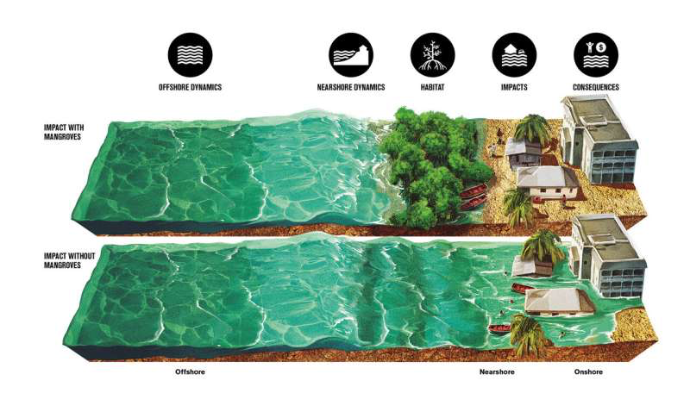
Mangroves protect the coast
Credit: World bank and Punto Aparte
Carbon storage
Mangroves are superheroes in the battle against global warming! How do they do it? Well, they soak up CO2 from the air like sponges as they grow. But other trees do that too. So, what makes mangroves so special? Well, regular trees have leaves that fall to the ground and rot, releasing the CO2 again. But many mangrove leaves don’t rot. They fall into the mud. Since there’s no air in the mud, the leaves don’t rot and no CO2 is released. In this way, they store the CO2 for a long time. Mangroves can store up to 4 times more CO2 per hectare than tropical rainforests! That’s why they’re so important in saving our planet from global warming.
Expansion of the tourist product
Tourists often think of mangroves as mysterious, exotic, and natural wonders. They imagine them as a unique ‘jungle on the water’ with winding roots, quiet creeks, and special animals. For many, mangroves are still unexplored, which adds to their allure of mystery and discovery. This makes mangroves a great addition to any tourist destination. Take the Curaçao Rif Mangrove Park, for example. The government of Curaçao built it, and the management has been outsourced to Carmabi. In 2024, around 21,000 visitors explored this amazing mangrove park.

Kajak tour Curaçao Rif Mangrove Park
Mangroves are super important for protecting the land and sea. But sadly, many places around the world are losing their mangroves. Curaçao is one of them. In the next article, we’ll dive deeper into this issue.