The White Mangrove
(Published in the newspaper Amigoe on the 24th of September 2025)
In the first part, we learned about the four types of mangroves on Curaçao: red, black, white, and buttonwood. Now, let’s focus on the white mangrove. The red mangrove is the closest to the sea, while the black mangrove grows further inland. The white mangrove is the most inland of all, which makes it crucial in preventing soil and contaminants from land from reaching the coral reef.
Name
The white mangrove is known as “Laguncularia racemosa” in Latin. “Laguncularia” comes from the Latin word “laguncul,” which means “vial” (bottle). This is because the fruits (see photo) look like a vial. “Racemosa” is based on the Latin word “racespar,” which means “cluster” because the fruits are grouped together.
Manner of growth
The white mangrove is a tree that can grow up to 12 to 18 meters high. Its leaves are roundish and a bit smaller than those of the red mangrove. The flowers are whitish, with 5 petals, and they grow in clusters on long flower stems.
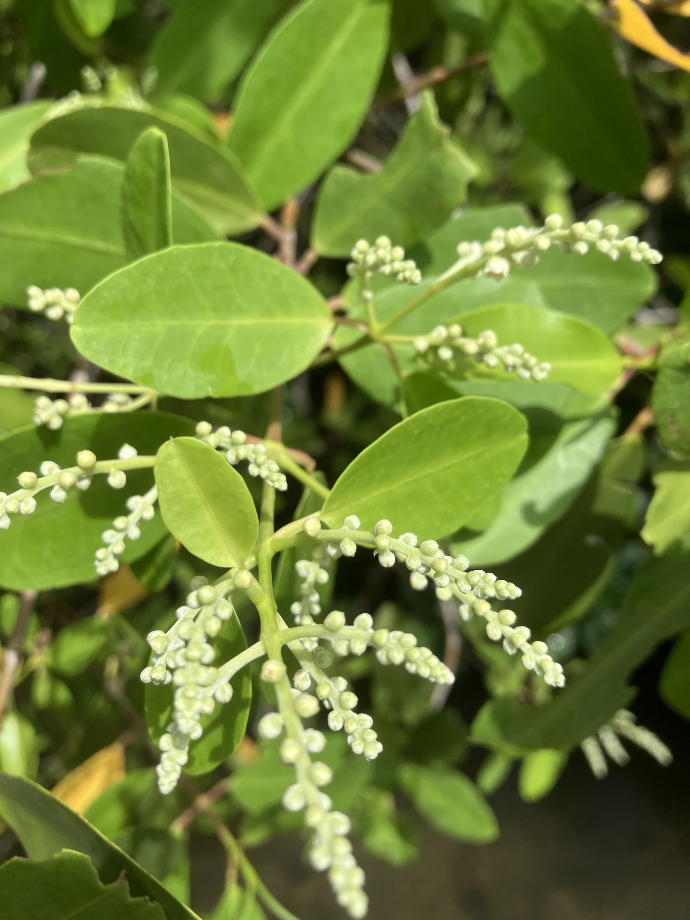
Leaves and inflorescence white mangrove
The white mangrove has two sugar glands at the base of its leaves. These glands attract ants, which are like little protectors for the plant. The ants love the sugar, so they come to the mangrove to feast. This way, the mangrove can defend itself against hungry leaf-eaters and other bad bugs. It’s like having a built-in army of ants!
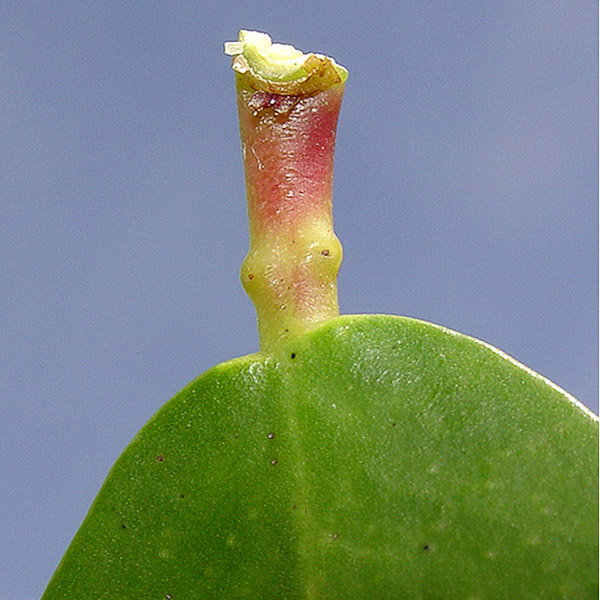
Two sugar-producing glands at the base of a white mangrove leaf
Credits: Treasure Coast Natives
The white mangrove tree has just one seed. It can float on water, and that’s how it spreads along the coast.

Fruits of the white mangrove
Stability
Just like the red and black mangroves, the white mangrove also grows in the muddy waters of the intertidal zone. That’s why it needs extra support too. So, the white mangrove has both stilt roots like the red mangrove and cable roots with pneumatophores like the black mangrove.
Salt resistance
The white mangrove has some cool ways to protect itself from salt damage. Its roots have a special filter that locks out most of the salt before it gets into the plant, just like the red mangrove. They also have special salt glands on their leaves, just like the black mangrove. These glands can actively filter salt from the sap and send it to the leaf surface, where it turns into crystals and can be washed away by rain or wind.
Respiration of the roots
The white mangrove, like the red and black mangroves, grows in soil that’s waterlogged. In such waterlogged soil, all the air trapped between soil particles is pushed out by the water. So, the roots can’t breathe in water-saturated soil. But the white mangrove has two clever ways to get its roots breathing. First, it has aerial roots that shoot up from the underground roots (pneumatophores), just like the black mangrove. And second, it has stilt roots that grow down from the trunk and can also breathe.
This article delves into the fascinating world of the white mangrove. It’s like the perfect blend of the red and black mangroves, offering the best of both worlds! Now, let’s move on to the last of the four Curaçao mangroves. This one is called the knot mangrove, also known as “buttonwood.” But here’s the interesting part: it’s not a true mangrove, but rather a mangrove companion that grows on land.