Watakeli: Robust and Ecologically Versatile Shade Tree for Curacao
(Published in the newspaper Amigoe on the 3rd of June 2026)
In the previous article, we discussed the wayaká, an evergreen tree, with a dense crown, a taproot, and applications in shipbuilding. This article discusses a shade tree that has an important ecological role in addition to being an important shade tree.
The watakeli
The watakeli (Bourreria succulenta) is a native tree that is well adapted to the dry conditions of Curaçao. It is a medium-sized tree that typically reaches a height of five to eight meters. The crown is slightly irregular in shape, which gives the tree a natural and somewhat whimsical appearance. The trunk is usually not perfectly straight and the bark has a grey-brown colour.
The leaves are relatively small, often shiny, oval and leathery, with a fresh green colour. Leathery leaves are an adaptation to limit water loss. We have seen in one of the previous articles that the sea grape also has leathery leaves. However, leathery leaves do not store water like cacti. Leathery leaves do give the tree more control over evaporation. When there is a shortage of water, evaporation is reduced. This allows trees with leathery leaves to survive in dry conditions. However, with enough water, evaporation is back to normal. Another example of a native shade tree with leathery leaves is the Mangel blanku (Conocarpus erectus) which is called buttonwood in English.
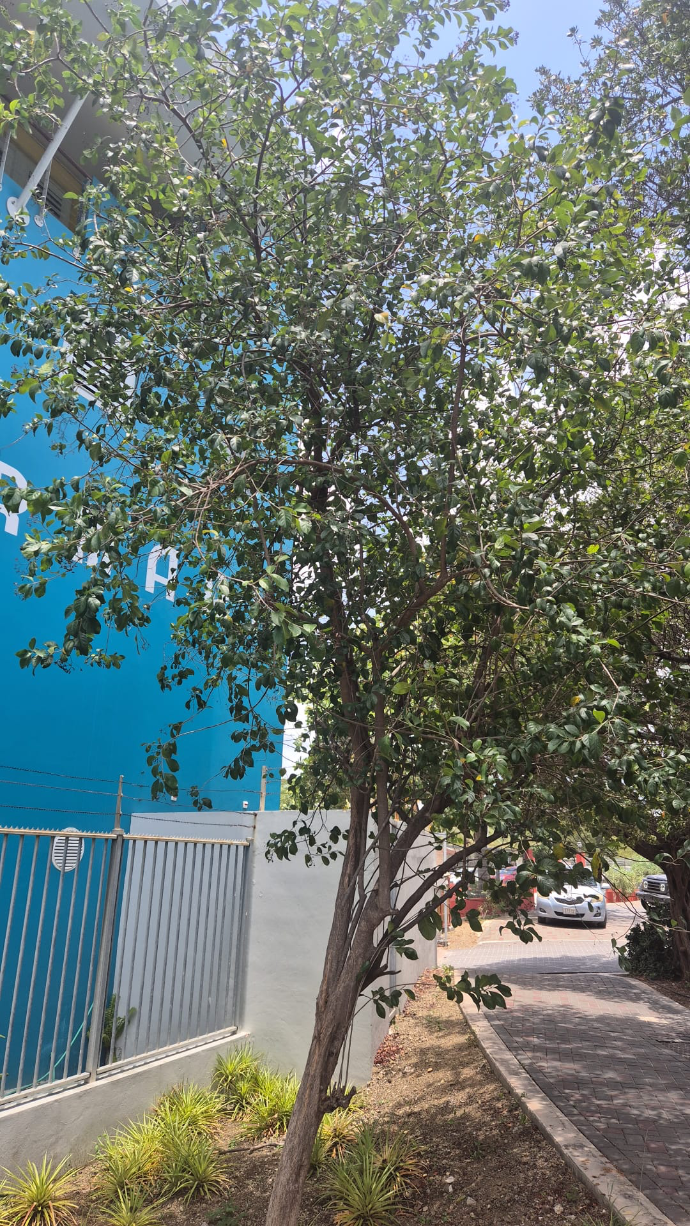
Watakeli in front of Carmabi building in Piscadera (Photo Duvan Rios)
The watakeli blooms with small, white flowers that are subtle but have a pleasant appearance. These flowers are followed by decorative orange fruits, with a diameter of more than a centimeter. The tree grows slowly to moderately fast and develops into a strong and resilient species that can withstand the conditions on the island.
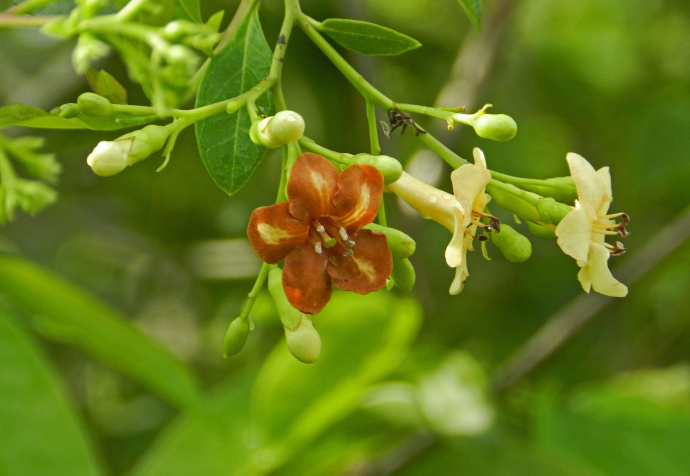
Flowers of the watakeli (Photo: R. te Hennepe)
The Watakeli is in fact a tough, drought-resistant native Caribbean tree that plays a disproportionately important ecological role. It is not striking in size, but extremely important. The pulp of the fruits of the watakeli is soft and juicy.
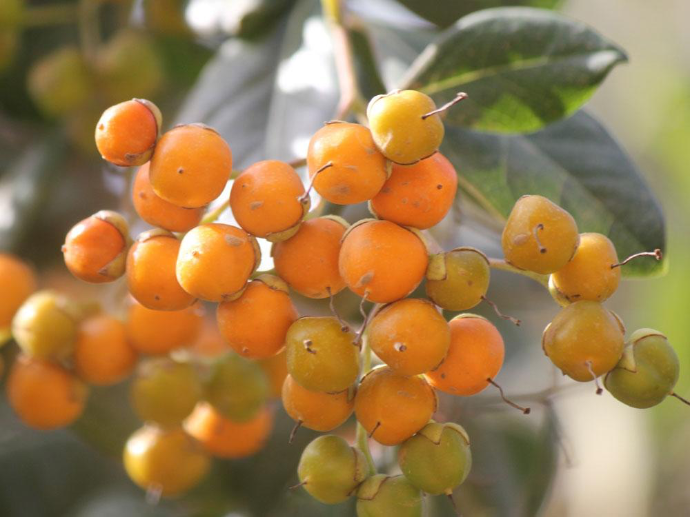
Fruits of the watakeli (Photo: R. te Hennepe)
The fruits are an important source of food for birds, such as the scaly-naped (Patagioenas squamosa) and probably also for fruit-eating bats. Fruit-eating bats love soft and juicy fruits. The scaly-naped pigeon, called blouduif in Papiamento, was quite rare before the 90s but can now be seen again in several places on the island. The nectar and pollen of the flowers of the watakeli are also attractive to various species of insects such as butterflies and bees. The watakeli survives harsh island conditions and can therefore play an important role in restoring damaged ecosystems.
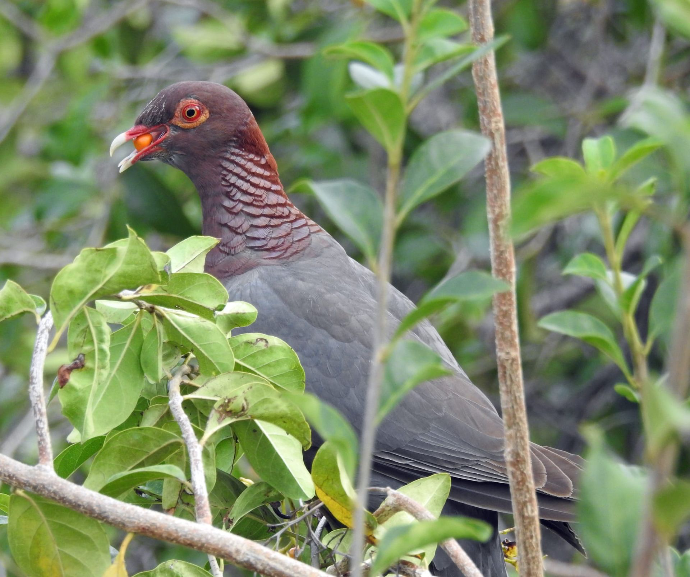 Fruits of the watakeli eating scaly-naped pigeon (Photo: R. te Hennepe)
Planting distance and tree pit
When planting the Watakeli, it is important to consider the final width of the crown. Because it can develop from four to six meters depending on the conditions, a planting distance of three to five meters is suitable if you want to achieve a continuous canopy. This makes the tree usable for streets, squares and school environments where shade is desired.
The distance to buildings can be relatively limited, usually around three to four meters. The roots are generally not aggressive and rarely cause damage to pavement or foundations. However, it is important to maintain a sufficiently large tree pit, preferably as large as the crown cross-section, but if this is not possible in the urban environment, as large as possible. Rainwater can infiltrate well and the tree can develop healthily, even in an urban environment.
Why suitable as a shade tree
The Watakeli is a suitable shade tree for Curaçao because it forms a fairly dense crown that effectively filters the sunlight. The shade is not completely closed, but it is pleasant and cooling, especially in places where full shade is not necessary.
An important advantage is that the tree is resistant to drought, wind and poor soils. This allows it to be used in a variety of urban situations, from residential areas to schoolyards. Its adaptability makes it a reliable choice in a climate where water is scarce and the sun is intense. Although the tree does not grow extremely large, it makes an important contribution to improving the microclimate, especially in medium-sized rooms. By providing shade and reducing heat build-up, it contributes to a more pleasant living environment.
What to look out for
With the Watakeli, it is important to take into account the growth form, which can be somewhat erratic and less predictable. This means that light guidance pruning in the initial phase may be desirable to develop a good crown structure, especially in urban applications where space is limited.
In the first years after planting, the tree needs regular water to take root properly. However, once established, it becomes very drought-tolerant and requires little additional care. The maintenance requirement is therefore generally low. The fruits can fall to the ground to a limited extent, but rarely cause a nuisance. The chance of branch breakage is also small, partly because the tree adapts well to windy conditions.
Other benefits
The Watakeli makes a valuable contribution to biodiversity on Curaçao. As a result, the tree helps to make urban areas more vibrant and ecologically richer. In addition, the tree has a natural and authentic appearance that fits well with the local landscape. As a native species, it contributes to the preservation of the island's original flora. This makes it not only functional, but also important from an ecological and landscape perspective.
Due to its combination of drought tolerance, modest size and ecological value, the Watakeli is a versatile tree that can be used well in the urban environment of Curaçao. It is a practical and sustainable choice for those who want to contribute to more shade, cooling and biodiversity on the island.
In this article, we have discussed the watakeli, a not too large but ecologically important shade tree. In the next article, we will discuss the mahok. This is a large and impressive shade tree that can provide a lot of shade in, for example, schoolyards and city squares.