The Wayaká: strong and always green Shade Tree for Curaçao
(Published in the newspaper Amigoe on the 20th of May 2026)
The sea grape was discussed in the previous article. This coastal tree with large leathery leaves is very salt-resistant and can be used as a shade tree as well as to stabilize (city) beaches. In this article, we will look at a slow-growing and evergreen tree with a dense crown and a root that goes straight down.
The Wayaká
The wayaká (Guaiacum officinale) is a characteristic, very slow-growing tree that fits well with the landscape and climate of Curaçao. It is a beautiful, evergreen tree with a dense, spherical crown. It has a smooth, green trunk that flakes. The parts that flake off are more gray in color and somewhat coarse. The wood is greasy, tough, very hard and sinks in water. The hard and greasy wood used to be, and still is, used for pulleys and ship shaft tubes on ships because it is self-lubricating. The beautiful flowers are light blue in color. The wayaká is called pokhout in Dutch. When heating the wood, a resin was extracted that was used as a medicine against syphilis. Syphilis was called Spanish smallpox in ancient times. Hence the name “pokhout” in Dutch.
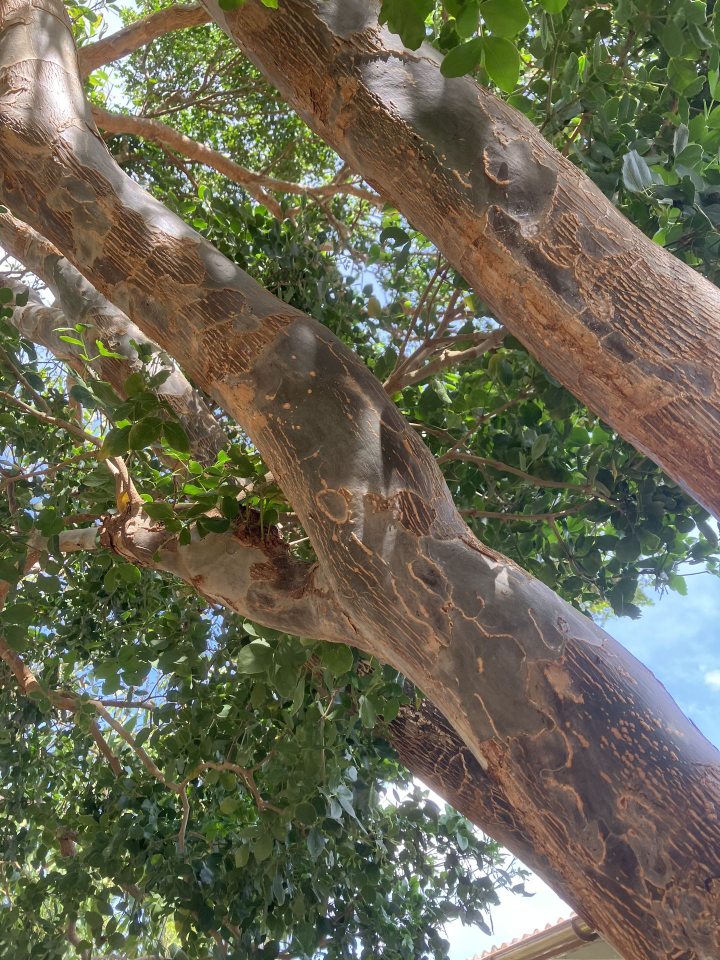
The wayaká
The wayaká also has a brother called the wayaká shimarón (Guaiacum sanctum). This tree is found on the limestone terraces on Curaçao and has a rough, gray trunk. The flowers are dark blue.
Planting distance and tree pit
When planting the wayaká, it is important to provide enough space for the crown to develop properly. Because the tree can reach a crown width of five to eight metres, a planting distance of five to seven metres is obvious if you want to create a continuous canopy. This is relevant, for example, in streets or squares where shade is desired.
The distance to buildings can be relatively limited, usually between three and five meters, because the roots do not fan out horizontally. Instead the wayaká has a taproot that goes straight down.
For healthy growth, it is essential to maintain a sufficiently large tree pit. As with other trees, the roots extend approximately to the edge of the crown. That is why it is wise to make the tree pit, the ground around the tree, as large as possible. Ideally, the tree pit should therefore have a diameter comparable to the final crown, i.e. 5 to 8 metres. In urban situations, this is often not fully feasible, but a spacious, unpaved zone around the tree helps the tree to stay healthy and increases the cooling effect.
Why is the wayaká so suitable as a shade tree
The wayaká is very suitable as a shade tree in Curaçao, especially because of its dense and evergreen crown. Unlike deciduous species, this tree provides shade all year round, which is a great advantage in a warm and sunny climate. The compact crown structure ensures that the sunlight is effectively filtered, which can significantly lower the temperature under the tree.
In addition, the tree is well adapted to local conditions. It can withstand long dry periods, can withstand strong winds and also tolerates salty sea air quite well. This makes it reliable as a shade giver in residential areas as well as in schoolyards and in urban areas where conditions are often challenging. Although it grows smaller than some other shade trees, it makes a valuable contribution to cooling in smaller spaces.

Walking in the shade of the wayaká
Furthermore, maintenance is limited. Pruning is rarely necessary and the chance of branch breakage is small due to the strong wood. The roots also usually do not cause damage to paving or foundations, which makes it suitable for urban applications.
What to look out for
Although the Wayacá has many advantages, there are also some points of interest. The most important is the slow growth. It takes a relatively long time for the tree to reach its full size and shade. This requires patience and a long-term vision when planting.
In the first years after planting, the tree needs regular water to root properly. Once established, the need for water decreases sharply and it can withstand drought well. The tree makes few demands on the soil and also grows on poor, rocky soils, but a good start remains important.
Other advantages of the wayaká
In addition to its function as a shade tree, the Wayacá also has an important ecological and cultural value. The beautiful flowers attract bees and other pollinators, which contributes to biodiversity in the city. This is especially important in petrified environments where nature is often scarce.
It is also popular for its ornamental value. The striking bloom gives color to streets and gardens and makes the tree recognizable and appreciated. The fruits have a beautiful yellow color.

Flowers of the wayaká (Photo John de Freitas)

Fruits of the Wayaká (Photo R. te Hennepe)
All in all, the wayaká is a strong, low-maintenance and attractive evergreen tree that fits well with the need for more shade and cooling on Curaçao. Its modest size and robust properties make it particularly suitable for use in the urban environment.
In this article, the wayaká has been discussed. In the following article, we will look at a medium-sized and evergreen shade tree that is well adapted to the dry conditions in Curaçao. This tree is known in Curaçao as the watakeli.