The Sea Grape: Natural Shade Maker along the Coast and in the City
(Published in the newspaper Amigoe on the 6th of May 2026)
In the previous article, the watapana (Divi Divi) was discussed. This excellent shade tree can withstand drought, grows in poor and rocky soil and is very wind resistant. In this article, we will discuss a tree that is particularly common near the coast and can withstand the salty air well.
The sea grape
Anyone who has ever walked along the coast of Curaçao has certainly seen it. We are talking about the tree with large, round leaves and bunches that resemble grapes. The sea grape is often called dreifi di laman in Papiamento because it grows on the coast. It is scientifically known as Coccoloba uvifera. It is a real coastal dweller. But it can also play an important role in making the environment cooler in residential areas and on schoolyards.
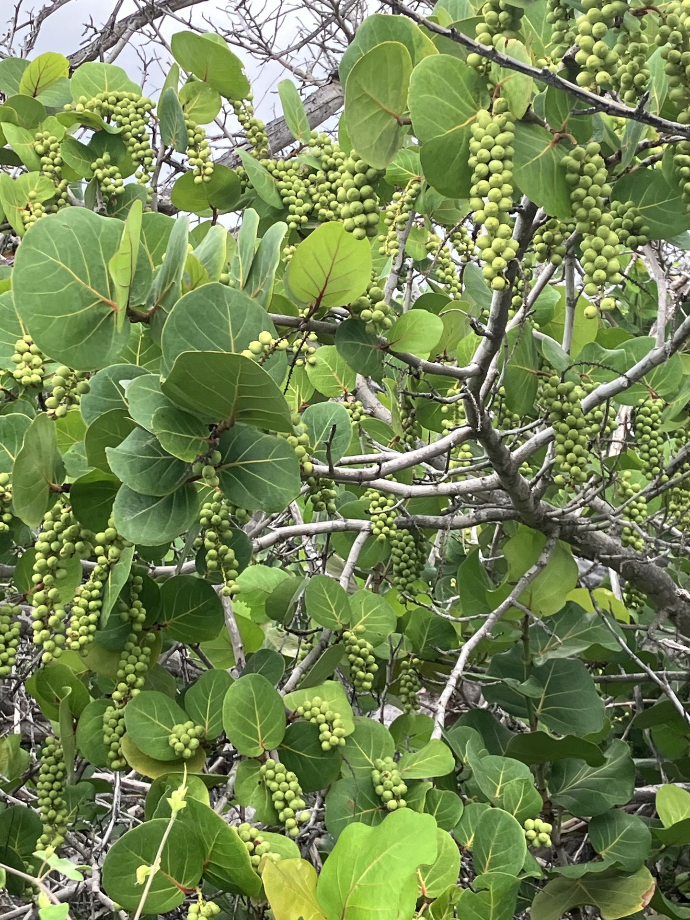
The sea grape
The sea grape is naturally adapted to sun, wind and salt. It originally grows along beaches and in coastal areas, where few other trees survive. As a result, he almost automatically does well on Curaçao. It can grow both as a shrub and as a tree. For use as a tree, you have to prune it. This means that you remove the twigs on the trunk to the height where you want the branching to start and the crown to form. If given space, it develops into a tree of 6 to 10 meters high with a crown that can reach a width of 8 to 10 meters.
As mentioned above, the sea grape can also grow on beaches. The sea grape is therefore ideally suited for stabilizing beaches. This also applies to city beaches. Stabilization of beaches is important to prevent sand from being washed away during storms. Especially when a hurricane passes north of Curaçao, it sometimes happens that sand on beaches on the south coast is swept away by the high waves because of the passing hurricane. Planting the sea grape on beaches is therefore an effective means of mitigating the damage. This can be in the form of sea grape bushes, but if you prune them into trees you also have natural shade on the beach.
What makes the sea grape special are large, leathery leaves. They are not only beautiful to look at, but also very functional. They block sunlight well and provide a pleasant, fairly dense shade. Under a fully grown sea grape, it can therefore feel significantly cooler, especially on hot, windless days. Like other trees, it also contributes to cooling by evaporating water through its leaves, although that effect is slightly less strong than with some larger shade trees.
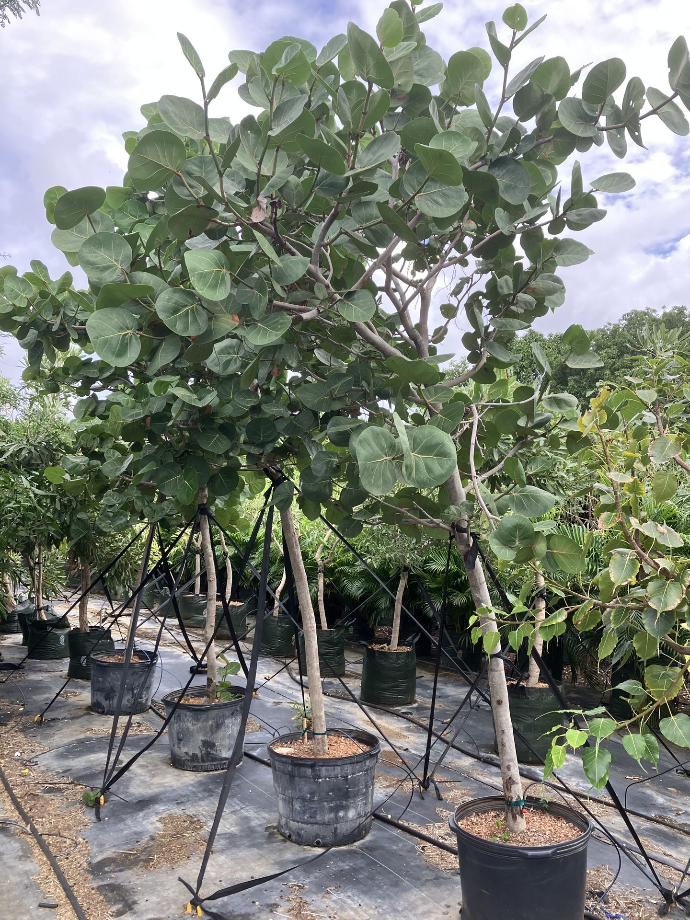
Cultivation of sea grape trees at Vivian's Nursery
Planting distance and tree canopy
The shape of the crown is usually broad and slightly domed. This makes the sea grape suitable for creating shade in strategic places, for example along walking routes, on squares or in schoolyards. If multiple trees are planted at the right distance from each other, their crowns can touch each other and form a continuous canopy together. With a crown width of 8 to 10 metres, a planting distance of 6 to 8 metres makes sense, depending on how quickly you want to achieve a closed shade zone.
The soil around the tree is also important. As with other trees, the roots extend approximately to the edge of the crown. That is why it is wise to make the tree pit, the ground around the tree, as large as possible. Ideally, the tree pit should therefore have a diameter comparable to the final crown, i.e. 8 to 10 metres. In urban situations, this is often not fully feasible, but a spacious, unpaved zone around the tree helps the tree to stay healthy and increases the cooling effect.
Why is the sea grape so suitable as a shade tree?
A big advantage of the sea grape is that it can withstand salty air very well. This makes it particularly suitable for streets and squares close to the sea. It also does well in streets where there is a lot of wind. In addition, it is resistant to drought and grows in poor, sandy or rocky soils. It is therefore relatively easy to maintain and needs little extra water once it has been started.

Cooling off on the coast under a sea grape tree
The tree also remains green all year round, providing continuous shade. This makes it attractive for places where people stay every day, such as schoolyards, playgrounds and terraces. However, there are also points of attention.
What to look out for
The roots of the sea grape are generally less aggressive than those of some larger trees. However, they can still push up the pavement if there is insufficient space. That is why it is wise to keep a distance of at least 4 to 6 meters from buildings and foundations. In places where space is limited, underground root protection plates can help prevent damage and steer the roots in the right direction. The fruits also require attention. When ripe, they fall from the tree and can stain pavement or cars. This is not a big problem in a park or natural environment, but less desirable in parking lots or directly along busy sidewalks.
Other advantages of the sea grape
The sea grape also has a social and cultural value. The fruits, which indeed resemble grapes, are edible and are sometimes used locally for jam or juice. That makes the tree recognizable and loved. The fruits of the sea grape are also an important source of nutrition for birds.
In earlier times, the leaves were occasionally used by the Spaniards to write on when lacking paper. Fishermen also incidentally wrote messages on the leaves of the sea grape if they had nothing else to write on.
The use of sea grape leaves for artistic purposes is also very interesting. In addition to making mosaics and ceramics, Marjon Wegman (1948-2024) has painted many leaves of the sea grape since the 90s. Only the naturally dried leaves could be used for this. After being framed in a special way, they last for years, up to 30 years. Princess Beatrix also owns such a leaf painting.
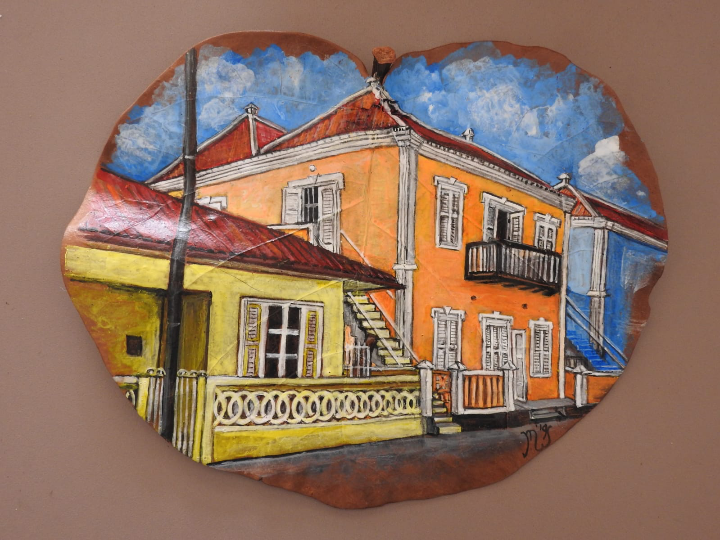
Cityscape painted on a leaf of the sea grape by Marjon Wegman
The sea grape is a valuable tree for Curaçao. It combines ornamental value with functionality and is particularly well adapted to the local climate. Especially in coastal areas and open, windy places where other trees struggle, it can grow into a reliable shade giver. For those thinking about greening, the sea grape is therefore a logical choice, as long as its final size and space requirements are taken into account. By keeping enough distance and maintaining a large tree surface, it can contribute to cooler, more pleasant places in the city.
In a warm island climate, shade is not a luxury but a necessity. The sea grape shows that with the right tree in the right place, we not only create cooling, but also a landscape that suits Curaçao itself.
In this article, we have discussed the sea grape. In the next article, we're going to talk about an evergreen, slow-growing tree with wood so heavy that it sinks in water. This tree also has a taproot that sometimes reaches the groundwater. This special tree is known in Curaçao as the wayaká, or pokhout as we call it in Dutch.