Smart Tree Planting: This is how you really make the City Cooler
(Published in the newspaper Amigoe on the 8th of April 2026)
In the previous article, we talked about the increasing temperatures and the benefits of (native) trees for lowering the temperature in the urban environment.
Planting trees in an urban environment is different from planting in nature. In the city, several additional factors have to be taken into account, such as limited growing space, the fact that streets, pavements and squares are often paved, the availability of water for irrigating the seedlings after planting and how and for what purpose the public space is used. Below are some tips and points of attention for successfully planting trees in the urban environment.
The goal
When planting trees in the city, and on school grounds, we must keep the main goal in mind. This is not primarily about landscaping or aesthetics, although we can of course take this into account. In the first place, it is about making the urban environment liveable on a naturally warm island that will become even hotter due to climate change. The priority is therefore shade. If you've been standing at a bus stop for an hour melting in the sun, waiting for a bus to come or not, the need for shade is suddenly very clear!
With streets and squares, it is important to know how wide the crown of the tree species you plant will eventually be. Based on this, the planting distance can be determined in such a way that the crowns just touch each other and together form a continuous canopy. In this way, you can walk permanently in the shade in, for example, a street or on a square. In addition, a large leaf mass is desirable! The leaves evaporate water and that evaporation cools the ambient air. The more leaves, the more evaporation and the greater the cooling effect. At the same time, this does mean that there must be sufficient water available in the subsurface. Trees can only cool effectively if they have enough water to evaporate!
Determining the height of the trees you want to plant
For a planting project with native trees in Willemstad, aimed at cooling and climate adaptation, the most optimal planting height is usually for medium-sized trees of 2.5 to 4 meters. This size strikes a good balance between survival rate, cost and rapid shading. Smaller trees (1.5–2.5 m) usually have the highest chance of rooting well and also need less water. These are advantages. However, it takes longer for them to provide effective shade and that is precisely what it is all about. Larger trees (>4–5 m) provide immediate cooling because they immediately provide shade. However, they are more expensive and require more water and aftercare to strike properly. In practice, therefore, the choice usually falls on a medium-sized tree.
Prevent damage from tree roots to building foundations and the road surface
The growth of roots of shade trees can lead to damage to building foundations and the pushing up of pavement. The type of root system, and the distance from buildings and pavements, is therefore an important factor in choosing the tree species you are going to plant. Tree species with a predominantly horizontal root system spread their roots close to ground level and therefore cause the pushing up of pavements and roads relatively quickly. They can also penetrate foundations, pipes, and sewers. Tree species with a taproot, on the other hand, develop a strong taproot that grows vertically into the depths. As a result, they are less likely to cause damage to foundations and pavement. The soil must then be sufficiently rootable.
Prevention of damage therefore starts with a careful choice of trees, and maintaining sufficient planting distance from buildings and pavements, where necessary. Modern techniques such as root-resistant screens, root guide plates and specially designed foundation edges can actively guide roots away from vulnerable zones. By combining these measures with regular management, damage from tree roots can be effectively prevented, while the valuable shade function of trees is preserved.
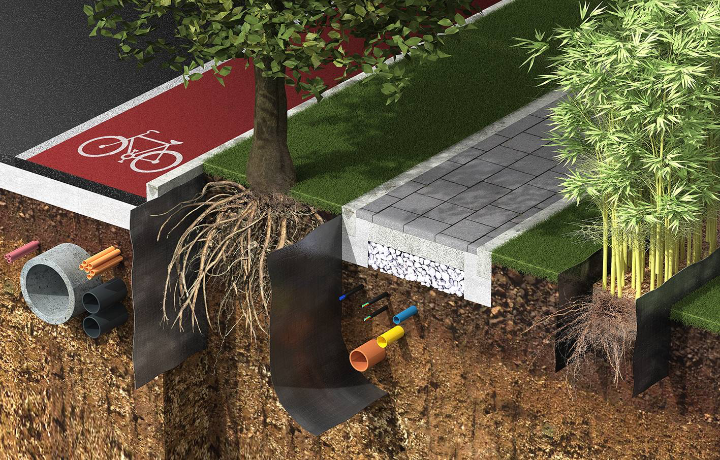
Root-resistant screens during the construction of a sidewalk and a cycle path
Taking into account trees already present during construction work
It is not always necessary to remove a tree when building houses or office buildings. You can take into account the tree that is already present during construction and incorporate it into the building.
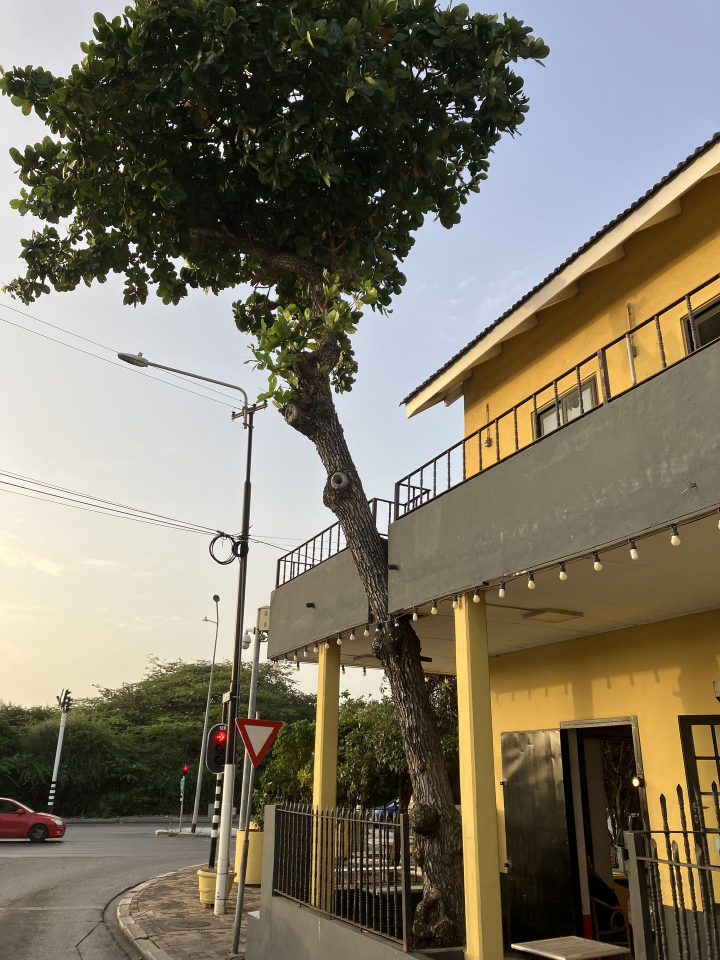
Tree in a balcony at Rio Canario
Avoid planting palms in the urban environment
It is sometimes thought that palms are a nice addition to the cityscape. In practice, however, they often offer few benefits when it comes to cooling. Palms usually have a narrow, translucent crown and therefore provide less shade. In addition, many palm species are susceptible to diseases and need a relatively large amount of water. In some species, heavy leaves or fruits, such as coconuts, may fall out of the palm. This is a safety risk for passers-by.
Furthermore, tourists are often looking for local culture and nature. However, palms are not part of a local experience. Most palm species onCuraçao come from outside Curaçao. The only truly native species on Curaçao is the sabal palm, which grows on Seru Bientu in the Christoffel Park, among other places. Therefore, if you want to offer visitors a typically local experience of the island, it makes more sense to opt for indigenous, shadier tree species that better suit Curaçao's landscape and climate. And if you're really looking for palms, book a tour to Seru Bientu in Christoffel Park where you'll see the majestic sabal palm in its natural environment.
Determine the correct size of the tree pit
What is the minimum tree pit required for a tree in pavement or asphalt? A tree pit is the piece of unpaved ground around the trunk that remains free of pavement, asphalt or concrete. In this open space, water can penetrate the soil and the roots receive oxygen and sufficient growing space. It is important to realize that tree roots need oxygen to "breathe". If the roots do not receive enough oxygen, they cannot breathe as well and absorb less water from the soil.
When planting in a paved environment, the mistake is often made to make the tree pit too small. A good rule of thumb is to make the diameter of the tree pit the same size as the diameter of the crown of the mature tree. In general, the root system under the ground reaches about as far as the branches and leaves above the ground. For example, if a mature tree has a crown of 6 meters wide, it is desirable that an unpaved zone of about 6 meters in diameter is available around the tree.

Tree pit the same size as crown
Another, often better solution, is not to place trees in a separate tree pits, but in a continuous strip of open ground. This gives the roots more space, water can infiltrate better and trees can develop healthier in the urban environment.
What are the consequences of a tree pit that is too small? If the tree is too small, the tree is more likely to suffer from drought stress. The tree also does not develop a good anchor and can blow over sooner. The tree also remains smaller, becomes more susceptible to diseases and often dies prematurely. Urban trees with tree pits that are too small sometimes only reach a fraction of their potential age. The roots will continue to look for space and grow up. This can push up paving stones or asphalt.
It is important not to pave or asphalt everything even where there are no trees. Strips of soil allow rainwater to infiltrate into the soil instead of flowing directly into the sea and being lost. This helps to replenish the groundwater. Trees with a taproot into the groundwater benefit from this!
In addition, less pavement contributes to a cooler urban climate. Pavement and asphalt absorb a lot of heat during the day and release it again at night. As a result, it often stays warmer in the city than in rural areas, especially at night. By preserving more open ground and greenery, this urban heat island effect can be reduced and the living environment remains more pleasant.
When digging, take into account what is underground
You can assume that there are usually electricity cables and water pipes in the subsurface along roads. In some neighborhoods, there are also sewer pipes underground. This should always be taken into account when digging planting holes. It is not the first time that cables have been accidentally damaged when planting trees, resulting in a power outage in the neighborhood.
Of course, when working in the subsurface, the available technical drawings on which pipes and cables are indicated must always be consulted. In practice, however, these drawings do not always turn out to be complete or up-to-date. Therefore, extra caution is required. Where possible, it is wise to have the exact location of pipes located before digging.
What do you do with falling leaves and fruits from trees?
Leaves and fruits that fall to the ground are part of the nutrientcycle. When the leaves and fruits rot, the nutrients are released and increase soil fertility. That is why it is good to leave leaves in tree pits so that they can rot and the nutrients become available again to allow the tree to grow.
Please also note the choice of types at parking spaces! For example, some trees are less suitable for parking spaces or where cars are parked. The black olive, for example, is a tree, which in general is certainly suitable for planting in an urban environment, but can cause problems for parked cars. The fruits are sticky and, if they fall on the car, may affect the paint.
The previous three articles discussed the importance of shade trees in the urban environment in general. In the following articles, we will go into more detail about those tree species that are suitable for planting in the urban environment with the aim of providing shade and lowering the temperature in the urban environment.