Neem - From Mirakel Tree to Intruder
(Published in the newspaper Amigoe on the 9th of September 2026)
Anyone who looks around on Curaçao sees him more and more often. Along roads, on vacant lots, between houses and also in the mondi there is a tree with a fairly dense green crown and pinnate, compound leaves with lanceolate, tapered leaflets that have a serrate/serrated leaf edge. The strongly branched panicles are in the axils of the leaves. The panicles look somewhat loose and drooping. The individual flowers are small, white to creamy white and fragrant.After that, yellowish fruits appear that look a bit like small olives. It is the neem, Azadirachta indica. A tree that originally does not belong on Curaçao at all.
Neem is also a particularly invasive species. Some exotics came to Curaçao centuries ago, so hardly anyone can remember their arrival. With neem it is different. It seems to have been introduced to the island only a few decades ago. So there are still Curaçaoans who can remember a time when neem was hardly or not at all seen here. The tree is now spreading itself.
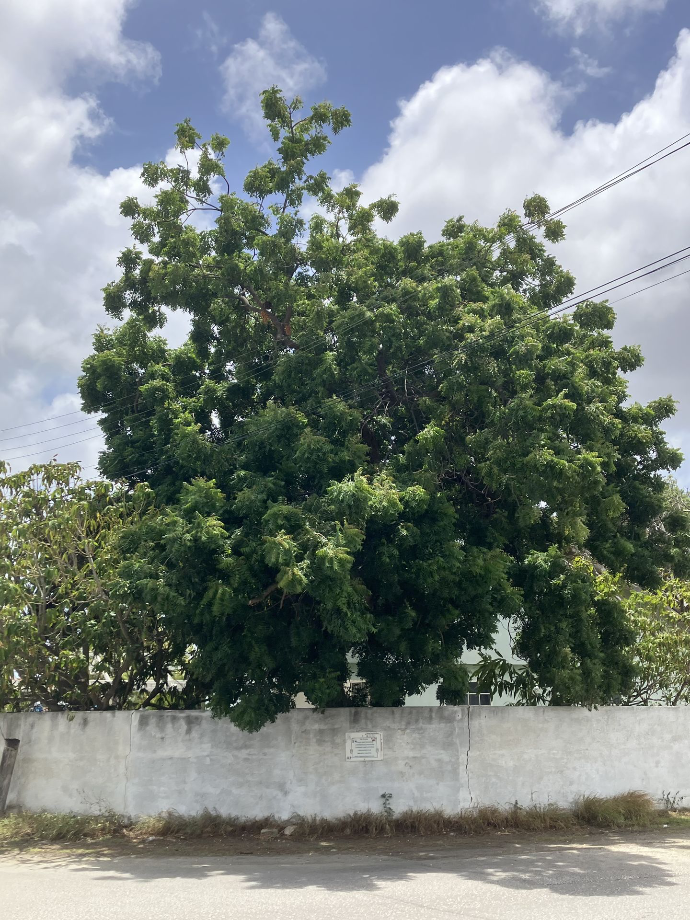 Neem tree in a garden
A famous tree from Asia
Neem is native to South Asia and is particularly strongly associated with India. There, the tree has been used for all kinds of purposes for centuries. Almost every part of the tree has been given an application. Leaves, bark and seeds are used in traditional medicines. Neem oil is pressed from the seeds. The wood can be used and the wide crown provides shade.
But neem became famous mainly for its effect against insects. The tree produces various substances that affect insects. The best known is azadirachtine. This substance can cause insects to eat less and can disrupt their growth and development. This created great interest in neem as a natural alternative to chemical pesticides. Especially towards the end of the twentieth century, neem gained an almost miraculous reputation internationally.
In 1992, the U.S. National Research Council even published a book called Neem: A Tree for Solving Global Problems. That was not only a nice title. Neem was actually presented as a tree that could help tackle all kinds of problems at once. It could withstand drought, grew fairly quickly, provided natural pesticides, provided shade and firewood and could be used against erosion. In addition, there was great interest in the possible medicinal applications. In short: a kind of miracle tree.
How did neem come to Curaçao?
We have not yet been able to find out exactly when the first neem tree was planted on Curaçao and who brought it here. We do know that his arrival must have been fairly recent. According to the Dutch Caribbean Nature Alliance, neem was introduced to Curaçao about twenty to thirty years before 2023. That would mean that the tree came to the island approximately between 1993 and 2003. This fits remarkably well with the period in which neem was strongly promoted internationally as a particularly useful tree.
What was once an attractive feature – a strong tree that grows easily in a warm and dry climate – turns out to have a disadvantage a few decades later. Because neem didn't stay neatly where people had planted it.
From garden to mondi
A plant is not automatically invasive because it comes from another country. Many exotic plants have been growing in Curaçao gardens for decades or hundreds of years without taking over nature. It becomes different when such a plant starts to reproduce itself, spreads and invades natural vegetation. That happened with Neem.
In research into invasive plants in the Dutch Caribbean, neem is now considered an important invasive species for Curaçao. The tree is not only found on disturbed areas and along roads, but can also penetrate natural vegetation. That is important. Some invasive plants need cleared terrain to establish themselves properly. Neem can benefit from such places, but is not completely dependent on them. And once it's up, it can become a big tree.
The fruits help him move forward
An important secret behind the spread of neem literally hangs on its branches. After the small white flowers, smooth, oval fruits emerge. At first they are green, later they turn yellowish. They look a bit like small olives. Such a fruit usually contains one seed.
The flesh is eaten by animals. Birds in particular can therefore be important for the spread of neem. They eat the fruit and take the seed to another place or spread it after the pulp has been digested. Bats can also spread fruits and seeds.
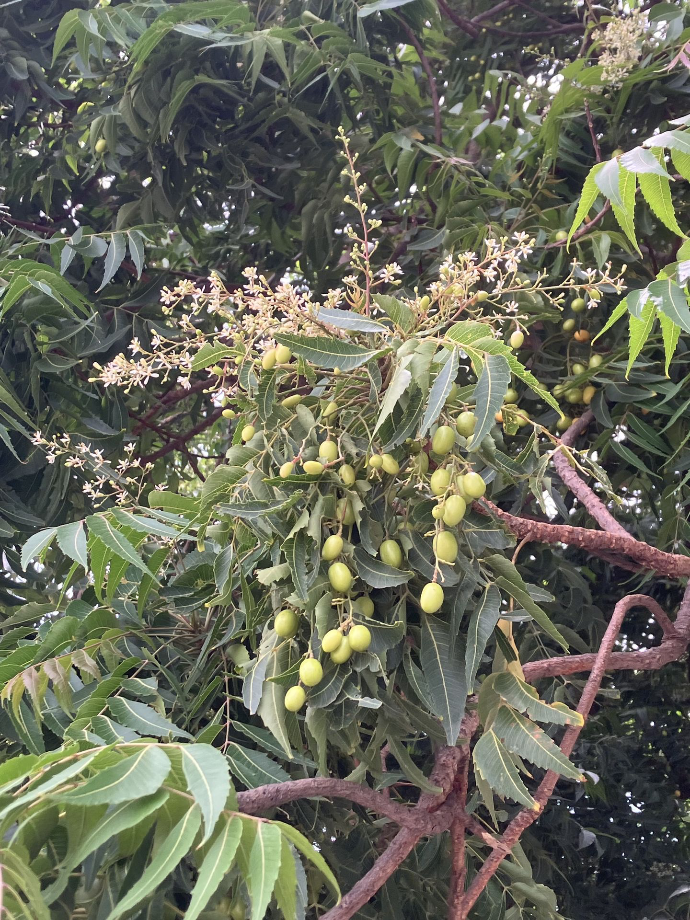 Neem, flowers and fruits
By the way, the seeds of neem do not have an exceptionally long lifespan. Unlike some invasive plants, build, do not pick up seed stock that has been waiting in the ground for decades. He doesn't need that either. An adult tree can produce large amounts of fruit every year.
Sawing off is not the same as removing
Anyone who sees an unwanted neem tree may think that the solution is simple: cut it down. This sometimes starts the next chapter. Neem has a strong and extensive root system. When the trunk is sawn off, that root system remains alive.
New shoots can then appear from the stump. Sometimes not one, but several at the same time. Before you know it, there is a bunch of new trunks in the place of one trunk.
So just cutting down the trunk does not automatically mean that the neem is dead. If you really want to remove it, you have to take into account the living stump and the root system, and then check for new shoots.
Why is neem a problem?
The fact that a tree grows easily is of course not bad in itself. In a garden, a neem can even be attractive. It grows quickly and provides a lot of shade. The problem arises when it spreads independently in nature. An invasive tree takes up space, water, nutrients, and sunlight. When many specimens grow together, they can change the conditions for the plants that occur naturally in Curaçao.
Neem also forms a fairly dense crown. Under such a tree, less light reaches the bottom. When several neem trees together form a dense vegetation, it becomes increasingly difficult for other plants to grow there. For example, an area that originally consisted of all kinds of different Curaçao trees, shrubs, cacti and herbs can slowly change.
And with that, more than just the landscape changes. Native plants have relationships with insects, birds, reptiles and other organisms that are sometimes thousands of years old. A local plant can provide food for certain insects. Those insects are eaten by birds or lizards. Fruits and flowers have their own users. A new tree cannot simply replace those complicated relationships.
A problem that is still young
Perhaps the most striking thing about assuming is that we are looking at an invasion in Curaçao that has probably only been going on for a few decades. With some other invasive plants, the damage has been done for much longer. Neem shows us almost in human time how fast something like this can go. First, a useful exotic tree appears. People plant it because it provides shade, can withstand drought and has all kinds of special properties. Then the first seedlings appear outside the garden. Birds take the fruits with them. New trees produce new fruits. And a few decades later, the same species is in all kinds of places where no one has ever planted it.
From miracle tree to warning
This does not mean that neem has suddenly become a worthless or bad tree. The qualities for which people admired him are real. Neem contains substances that affect insects. The oil has useful applications. The tree tolerates drought and can recover quickly after being damaged. But that is precisely where the irony lies. The traits that made neem a "miracle tree" also help him become a successful intruder.
When we bring a new plant to Curaçao, we should therefore not only look at what that plant can do for us today. We also have to ask ourselves what he can do in twenty, fifty or a hundred years. Because sometimes today's miracle tree turns out to be tomorrow's invasive species.