More Shade, More Life
(Published in the newspaper Amigoe on the 15st of July 2026)
In the previous articles we have paid attention to the watapana (divi divi), the sea grape, the wayaká, the watakeli and the mahok, the mata piská, the indju, the ròmbeshi and the kalbas. In this article, we will discuss the last four shade trees in this series. These are the oliba, the palu pretu, the romangel and the tamarind.
Oliba: graceful tree with ecological value
The oliba (Quadrella odoratissima, formerly Capparis odoratissima ) is an elegant, evergreen, native tree that is best known for its beautiful and fragrant flowers and natural beauty. The leaves are leathery with a shiny top. The flowers attract pollinating insects, so the tree contributes to the biodiversity of the urban environment.The flowers of the oliba initially open white to creamy white, making them clearly visible to pollinators. After pollination or as the flower ages, the petals gradually turn pink to purple. This allows both white and purplish flowers to be observed on the same tree during the flowering period.The fruits are eaten by birds.
Due to its modest dimensions, the oliba is suitable for smaller public spaces, school grounds, community gardens and residential streets where larger tree species are less suitable. Below a picture of an oliba tree in the mondi. For use as a shade tree, you must of course prune it to get a trunk.

Oliba (Photo: John de Freitas)

Flower of the oliba (Photo: Erik Houtepen)
Palu pretu: brother of the oliba
The palu pretu (Quadrella indica, formerly Capparis indica) is a valuable native shade tree for Curaçao. He is related to the oliba. Compared to the oliba (Quadrella odoratissima), Quadrella indica has the advantage that it usually develops a denser and more closed crown, which allows it to provide shade more effectively.
Due to its excellent drought and wind resistance, the palu pretu is particularly suitable for use in the city centre, residential areas and on school grounds. Because the species is naturally adapted to local conditions, it requires relatively little maintenance and irrigation. In addition, the tree makes an important contribution to biodiversity by providing food and shelter for birds and insects.
These advantages are offset by some limitations. The tree grows relatively slowly, so it can take several years before a meaningful shading effect is achieved. In addition, the crown usually remains smaller and less wide than that of many traditional shade trees, so the amount of shade is limited in larger squares, playgrounds or parking lots. Young trees also require some topiary to obtain a well-developed crown structure. As a result, palu pretu is mainly suitable as a medium-sized shade tree or as part of a varied tree planting, and less as the only solution for large-scale shading.

Palu pretu (Photo: John de Freitas)

Flowers of the palu pretu

The fruits of the palu pretu are loved by the birds
Romangel: robust and versatile
The romangel (Conocarpus erectus) is a tree that occurs naturally in the transition zone around mangrove areas. The romangel is also known as the mangel blanku. However, the name mangel blanku leads to confusion because there is also another mangrove species that is called the white mangrove in Dutch, which in turn translates to mangel blanku in Papiamento. That is why we prefer the name romangel.
The romangel is a coastal tree by nature and is known for its great tolerance to drought, salt and wind. The crown remains green all year round and can provide a pleasant shade. This makes the species particularly suitable for coastal areas, parking lots, wide streets and schoolyards. In addition, the romangel requires relatively little maintenance, which makes it attractive for use in public spaces.
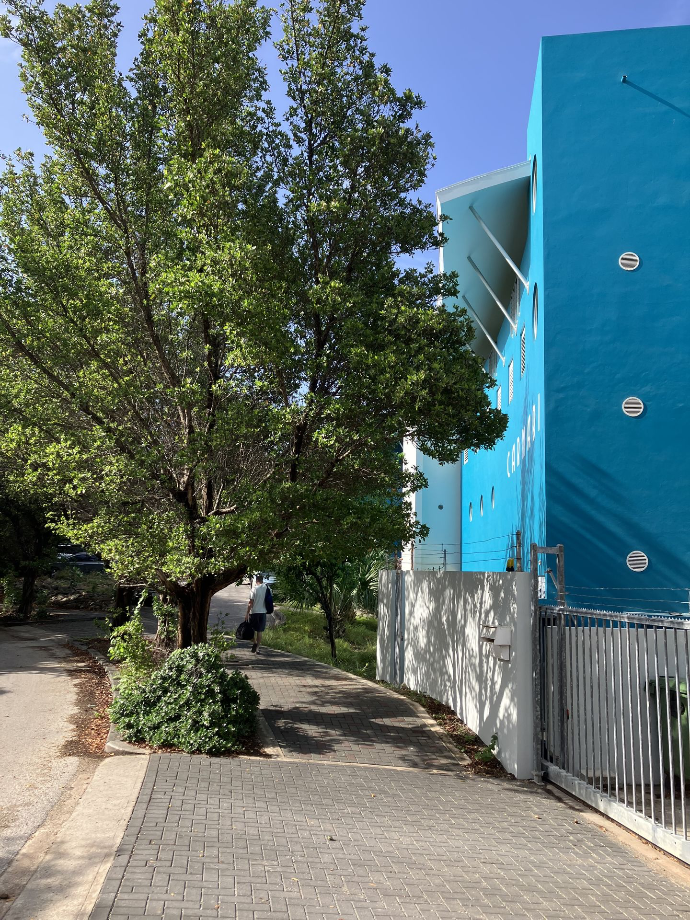
Romangel in front of the Carmabi building in Piskadera (Photo: Paul Stokkermans)
Tamarind: a green giant with cool shade and sour fruits
The tamarind (Tamarindus indica) is not a native tree of Curaçao, but it is a tree that has been part of the landscape of the islands for centuries. It is particularly interesting for the city because it forms a wide, dense and cool crown. The fine, pinnate leaves filter the bright sunlight and provide a pleasant shade. Unlike many flowering ornamental trees, the tamarind remains green almost all year round in the dry climate of Curaçao, making it an excellent shade tree even in the dry season.
An adult tamarind can reach a height of 15 to 20 meters and develops a crown with a diameter of about 15 to 20 meters. As a result, it is not suitable for narrow pavements or small planting areas, but it is suitable for parks, schoolyards, spacious yards, wide verges where sufficient growing space is available. It grows slowly, but can become very old. Under favorable conditions, it often reaches the age of 150 to 200 years. A tamarind tree can therefore last for generations and grow into a striking landscape tree. That is why they are planted as shade trees in many tropical countries.
The flowers of the tamarind are small and graceful. The brown pods contain a dark brown, sweet and sour pulp that has been used in cooking for centuries. On Curaçao and elsewhere in the Caribbean, a refreshing drink is made from it. The pulp is also a popular ingredient in chutneys, sauces, sweets and marinades. Worldwide, tamarind is best known as a seasoning in Indian, Southeast Asian and Latin American cuisine, where it gives the characteristic fresh, slightly sour taste to many dishes.
The fruits do require some attention when the tree is used in the city. Ripe pods eventually fall to the ground. The pods are normally not heavy enough to cause damage to vehicles. However, they can create a mess or leave sticky residue on cars and pavement. That is why the tamarind is less suitable directly above parking lots or busy terraces, but forms a sustainable and particularly valuable shade tree for Curaçao in spacious locations.

Flowers of the tamarind (Photo: Rien te Hennepe)
Working together on a cooler Curaçao
In the previous articles we have paid attention to the watapana (divi divi), the sea grape, the wayaká, the watakeli, the mahok, the mata piská, the indju, the ròmbeshi and the kalbas. In this article, we have discussed the oliba, the palu pretu, the romangel and the tamarind. Of course, Curaçao has more tree species that can provide shade. However, it would take too long to cover all of them in this series. With these thirteen species, a representative selection has been made of trees that, each in their own way, can contribute to a greener, cooler and more livable Curaçao. In the next, and also last article in this series, we will once again discuss the importance of shade trees for the city.