Mahok: From precious Wood to indispensable Shade Tree for the City
(Published in the newspaper Amigoe on the 17th of June 2026)
The previous article was about the watakeli, a relatively smaller tree. In this article, the mahok is discussed. The mahok is a tall and imposing tree with a broad crown and therefore offers a lot of shade and cooling when mature.
Mahok
Mahok, as the West Indian mahogany is called in Curaçao, is one of the most special trees in the Caribbean. The species, scientifically known as Swietenia mahagoni, has been known for centuries for its beautiful reddish-brown wood. Mahogany is considered one of the most beautiful and valuable woods worldwide.
The history of mahogany is closely linked to that of the Caribbean. From the seventeenth century onwards, the wood was widely exported to Europe, where it was used for luxury furniture, ship interiors, musical instruments and refined carpentry. The combination of beauty, durability, and excellent machinability made mahogany a beloved material among cabinetmakers and craftsmen. Below is a piece of furniture from the book "Craftmanship in mahogany" The Musk Furniture Industry and the history of C.F.Muskus & Co "El Ancora". The book describes the history of both the Musk furniture industry from 1940 to 1955 as well as the history of C.F.Muskus & Co "El Ancora" on Curacao and is enriched with beautiful color photos of the mahogany Musk furniture that is still present on Curacao.
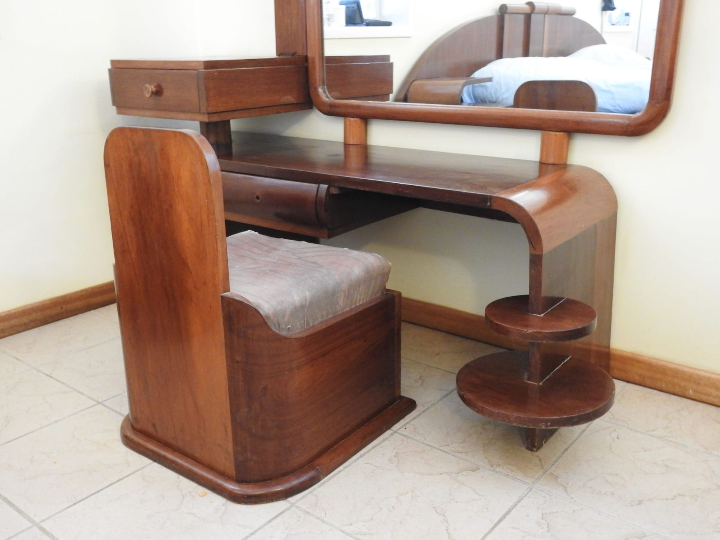
Mahogany dressing table belonging to mahogany bedroom set
The real mahogany is of the genus Swietenia. There are three classic species, namely Swietenia mahagoni (West Indian or Cuban mahogany), Swietenia macrophylla (large-leaved mahogany) and Swietenia humilis. Of these three, the mahok, the West Indian mahogany, was historically the most prestigious. The wood was exported from the Caribbean for centuries until the natural supplies were greatly depleted.
Although the mahok tree is native to parts of the Caribbean and South Florida, the mahok tree has adapted well to local conditions in Curaçao. Old mahok trees can still be found at country houses, along roads and in gardens, where they contribute to the character of the island. The mahok was traditionally used in Curaçao as valuable lumber and furniture wood. On Curaçao, wood has always been a relatively scarce commodity. Large forests such as on some other Caribbean islands were lacking, so people were careful with usable trees. Old mahok trees that grew on plantations, near country houses, or along roads sometimes provided wood for local use. On Savonet, for example, you had a planting of mahok trees that is still known today as the mahok forest. Especially because of its durability, stability and beautiful reddish-brown color, it was a popular material for artisan furniture makers and carpenters.
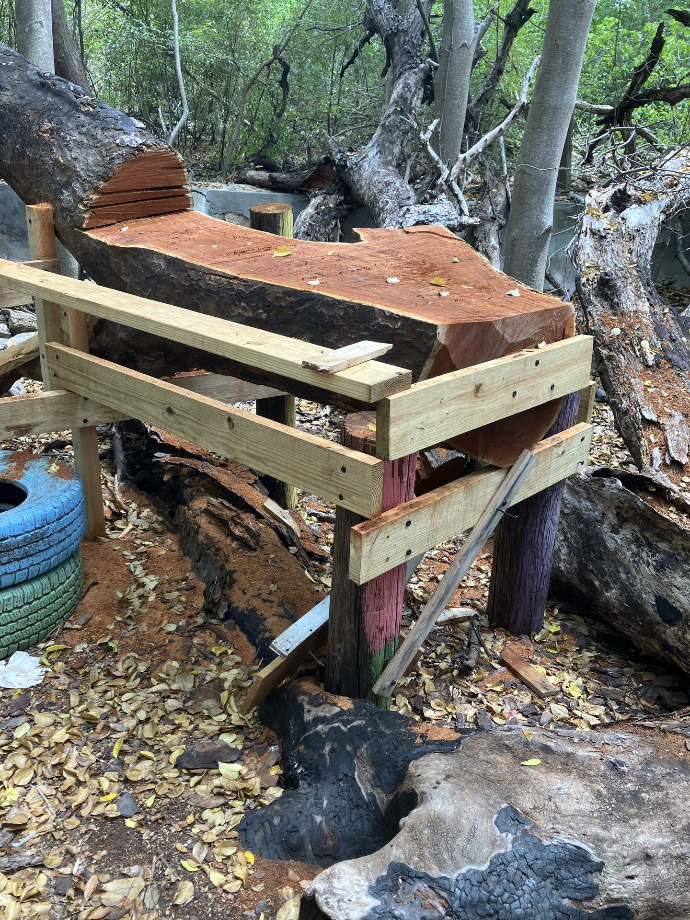
The processing of a fallen mahok tree on Savonet
Today, the mahok is not only a reminder of Curaçao's rich nature, but also an important chapter in the economic and cultural history of the Caribbean. This impressive tree remains a living symbol of beauty, sustainability and heritage.
On Curaçao, the mahok is not only a source of valuable wood, but also a characteristic shade tree. With its wide crown, it provides cooling in a warm and dry climate. The tree can grow tens of meters tall and is easily identified by its shiny compound leaves and large woody fruits that pop open to release winged seeds. The mahok grows relatively quickly, especially compared to many native species. This makes it attractive for situations where a lot of shade is desired in the shorter term.
Planting distance and tree pit
Although the mahok usually only reaches a height of 10 to 20 meters in Curaçao, it is mainly its wide crown that makes it so valuable. A mature tree can provide a large area of cooling shade and thus contributes to a more pleasant urban climate. The crown can reach a width of 10 to 18 meters. As a result, a planting distance of at least 8 to 12 meters is required to get a well-developed and continuous canopy. In avenues, or on large squares, this tree can form an impressive shade canopy.
The distance to buildings and paving should be larger than with smaller trees, preferably six to eight meters. The roots are more vigorous and need more space to develop properly. For shorter distances, underground root screens are required. In urban situations, a large tree pit of at least 16 square meters is essential so that sufficient water and oxygen can reach the soil. Although the Mahok can grow well in paved areas, sufficient underground space and a good layout of the growing site are required.
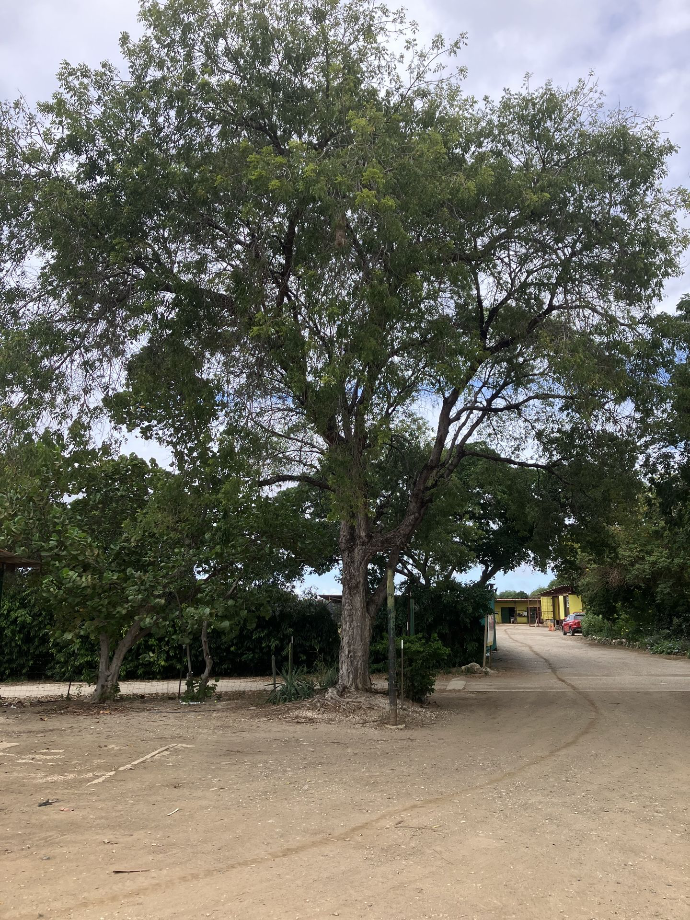
Mahok tree at Vivian’s Nursery
Why suitable as a shade tree
The Mahok is ideally suited as a shade tree because of its large, dense crown. It provides a deep, cool shade that is particularly effective at lowering the temperature at street level. This makes it very valuable for wide streets, schoolyards and parks.
Its rapid growth makes it ideal for places where you want to see results quickly. The mahok is a fantastic choice for squares or wide streets where you want to create a lot of shade quickly. The mahok can be used as an avenue tree in a row planting or as an iconic solitary tree on a small square. In schoolyards, you can build a cozy, round bench around it where the children can enjoy the coolness during the break.
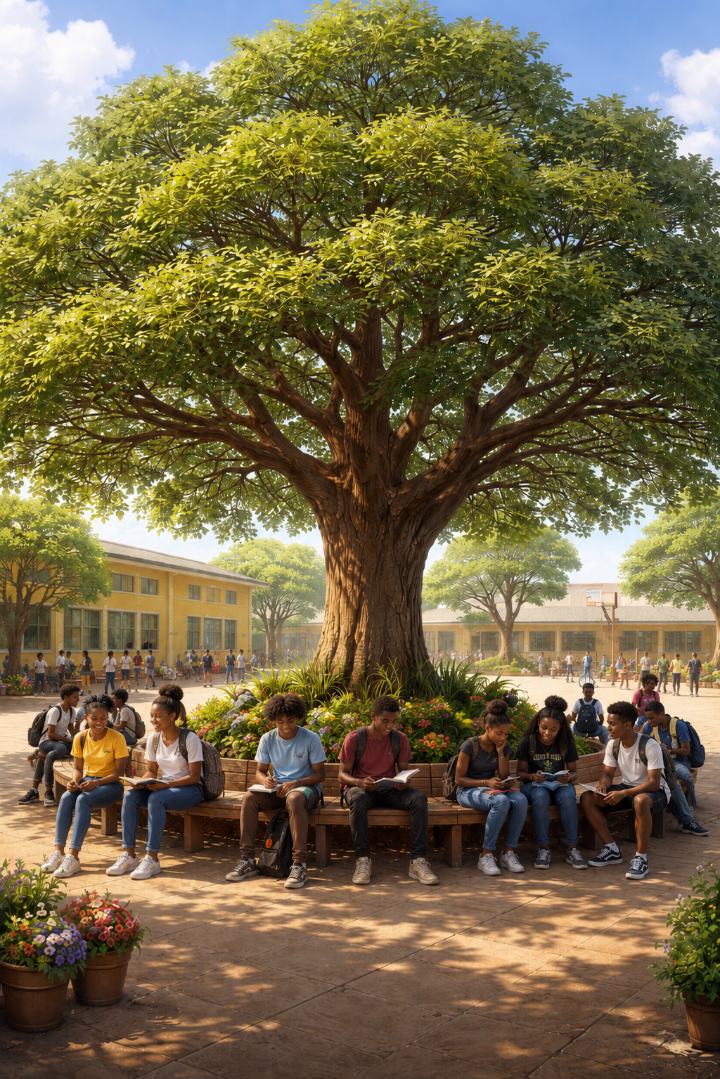
Recovering from class under a mahok tree
In addition, the tree is evergreen, or only slightly deciduous, so it provides shade for most of the year. The combination of a large leaf surface and a sturdy crown structure ensures a high cooling capacity. The Mahok copes reasonably well with dry conditions and wind and has a good tolerance for salt spray near the coast.
What to look out for
With the Mahok, it is important to consider the final size of the tree from the start. It is less suitable for narrow streets or small gardens, because it quickly becomes too big there. In such situations, it can cause conflicts with buildings, cables or other infrastructure.
The roots are powerful and can cause problems with paving if there is insufficient space underground. Underground root screens are then required. A good choice of location and sufficient underground growing space are therefore essential. In the first few years, the tree needs regular watering to establish itself properly, but after that only relatively low maintenance is needed.
There may also be some fruit fall, because the woody seed pods end up on the ground. This is usually not a big problem, but it can require attention in certain situations, such as parking spaces.
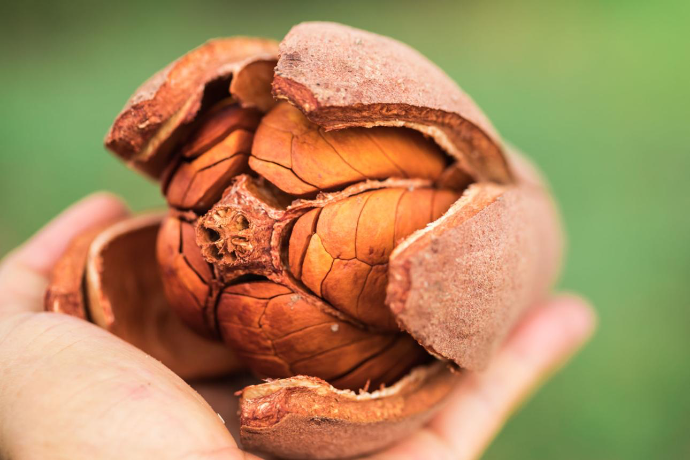
Cracked fruit of the mahok
Like all large, long-lived shade trees, mature mahogany trees require periodic maintenance. As trees age, some branches may die naturally or become weakened by drought, storm damage, decay or poor branch structure. Large dead or weakened limbs can eventually break and fall, posing a risk to pedestrians, vehicles, schoolyards and playgrounds. This risk is not unusually high compared with many other tropical shade trees, but it underscores the importance of a proactive tree management programme. Regular inspections, timely removal of deadwood, structural pruning during the early years of growth, and protection of the root zone can greatly reduce the likelihood of branch failure. With adequate space and professional maintenance, the benefits of Swietenia mahagoni as a shade tree generally far outweigh the manageable risks associated with falling branches.
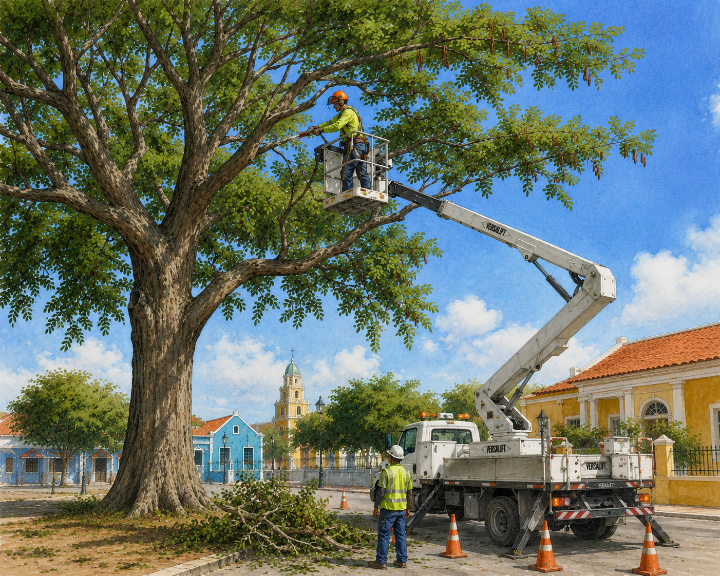
Pruning work using a boom lift
Other benefits
The Mahok not only has functional value as a shade tree but also has a strong aesthetic and economic significance. It is one of the most famous woods in the world, appreciated for its durability and beautiful structure. This also gives the tree a certain status and recognizability.
In addition, it contributes to the greening of urban areas and provides living space for birds and insects. Due to its size and long lifespan, it is an investment in the future. It is a tree that can contribute to a cooler and more pleasant living environment for generations.
The Mahok is therefore especially suitable for places where there is room for large trees and where maximum shade is desired. In that context, it is one of the most effective choices for Curaçao.
In previous articles, we have discussed into detail various shade trees appropriate for the city. The forthcoming article will be the last article of this series on shade trees for the city. In this article, we will explore a diverse range of other suitable shade trees that can be utilized in urban settings.