Building a Cool Curacao, one Tree at a Time
(Published in the newspaper Amigoe on the 29th of July 2026)
In the past ten articles, we were introduced to thirteen shade trees that fit well with Curaçao: the watapana, also known as the divi divi, the sea grape, wayaká, watakeli, mahok, mata piská, indju, ròmbeshi, kalbas, oliba, palu pretu, romangel and tamarind. These trees differ in size, growth rate, shape and uses. What they have in common is that they are native or have adapted excellently to the dry, warm and windy conditions on our island. Together they form a valuable range for the greening of our neighbourhoods, school grounds, squares and city centre. Because good tree planning is not just about planting more trees. At least as important is planting the right tree in the right place.
Why variety is important
When a certain tree species is doing well, the temptation can be great to plant that species everywhere. This seems simple and efficient, but it comes with risks. A disease, insect plague or extreme weather condition can hit that one species hard. When a large part of the urban greenery consists of the same tree, many trees can be lost in a short time. A varied tree stock is therefore stronger and more resilient. Variation also helps biodiversity. Some trees provide food or shelter for birds, while others are especially attractive to bees, butterflies, and other pollinating insects. A green city is therefore not built with one miracle tree, but with a well-thought-out combination of species.
The right tree in the right place
Not every tree is suitable for every location. In a narrow street or alley, a smaller tree is often wiser than a species that can grow tens of meters wide. On a spacious square, a large crown may be desirable, because it provides a lot of shade.
The distance to buildings is also important. Some trees mainly develop a deep taproot. Other species have roots that spread widely close to the surface. Such roots can push up pavement or cause problems with walls, foundations and sewers. On the coast, a tree must be able to withstand salty air and splashing seawater. In open and windy locations, a sturdy tree is needed that does not lose branches easily. In very hot places, where shade is desired quickly, the choice may fall on a relatively fast-growing species. The available space also determines how big the tree can be when planted. A larger tree is more likely to provide shade, but is more expensive and requires more attention during transport, planting and care. Trees must also be ordered in good time. Suitable varieties and sizes are not always immediately available. Sometimes young trees have to be specially cultivated, and that takes time.
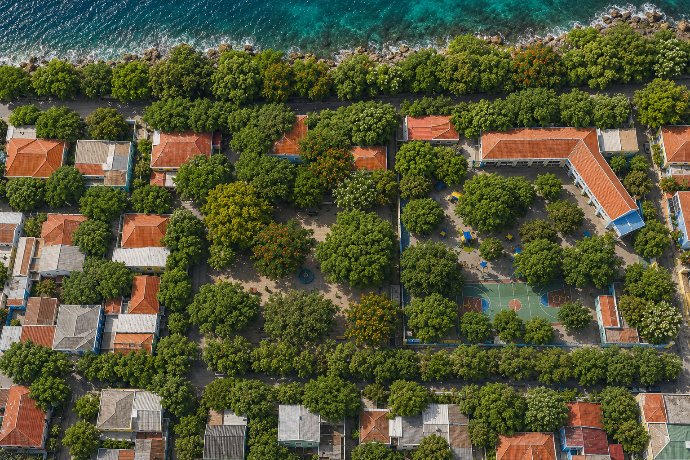
Don't just look above, but also below the ground
When planting a tree, you should not only look at the space for the trunk and the crown. At least as important is what is underground. In urban areas, there are often electricity cables, water pipes, sewage pipes and fiber optic cables. Before digging starts, it must therefore be clear where these facilities run. Tree roots also need space. They need to be able to absorb water and nutrients and need oxygen. A small hole in a fully tiled plaza is usually not enough to keep a large tree healthy for decades.
Where possible, a continuous planting strip is preferable to separate small tree canopies. This allows more rainwater to reach the soil, there is more room for roots and the soil can breathe better. When a tree species has widely growing roots, root screens can be installed. This controls the roots and keeps pipes, foundations and paving better protected. Careful choice is also required for parking spaces. Trees that drop large, heavy or heavily staining fruits are not always suitable over parked cars.
No healthy tree without water
Even trees that can withstand drought well need regular watering after planting. Especially in the first year, their roots still have to develop. In larger planting projects, it is wise to determine in advance how the trees will be watered. This can be done with an irrigation system for which a water connection must be available in the public space. When a water truck is needed, the planting locations must be accessible.
Shade trees as protection against heat
Curaçao is already dealing with high temperatures. Climate change will cause temperatures to rise and warm periods are likely to occur more often and last longer. This only increases the importance of shade in public spaces. That cooling is important for everyone, but not everyone is equally well protected against heat. People with a low income cannot always afford an air conditioner or the associated electricity bill. Especially in neighbourhoods where homes are small and warm and there is little public green space, shade trees can make a big difference. In the greening of Curaçao, neighborhoods with many people with low incomes, with few trees and little shade therefore deserve extra attention.
Cooler schoolyards
Shade is also urgently needed in schools. Work is being done in various places to install air conditioning in classrooms. This can bring relief during lessons, but air conditioners use a lot of electricity and do not solve the problem outside the classroom. A schoolyard without shade remains very hot in the middle of the day. Children then hardly have a cool place to play, move or relax during the break. That is why schools should invest in shade trees at the same time as installing air conditioners. Trees can help lower the ambient temperature around the buildings, making classrooms less likely to heat up. This can limit the electricity bill.
Attention to the elderly and visitors
Older people are extra sensitive to heat. As people age, the body's temperature regulation often works less well. Sufficient shade at bus stops, walking routes, care institutions, shopping areas and meeting places is therefore not a luxury. Visitors are also not always used to the warm climate of Curaçao. There are also many elderly people among tourists. A city centre with little shade and large areas of hot concrete or asphalt can become unpleasant on hot days. Comfortable walking routes, green squares and shady resting places are part of a hospitable environment. Investing in trees is therefore also investing in the quality and attractiveness of Curaçao as a destination.
Knowledge and education
Knowledge is needed for a successful tree policy. This applies to policymakers, designers and implementers, but also to residents and schoolchildren. Climate change and greening should therefore be given a clearer place in education. Children can learn why trees are important, how they grow and which species suit Curaçao. A school site with trees can even be used as an outdoor classroom. Today's schoolchildren are the residents, entrepreneurs and policymakers of the future. Those who learn at a young age how important nature and shade are, will be more willing to handle them carefully later on. There must also be sufficient knowledge within the government and other organisations. Where that knowledge is lacking, training and practical courses are needed. After all, a wrongly chosen or wrongly planted tree can cause problems for years. A good choice will actually benefit you for decades.
Greening requires policy and budget
Planting trees costs money. Planting material must be purchased, soil must be prepared and young trees sometimes need to be irrigated the first year and some species require side branches to be removed to form a crowned trunk that you can walk under. Yet, in the long run, urban greening is often cheaper than relng solely on technical cooling, such as air conditioning. Adaptation to climate change must therefore be given a permanent place in the public budget. The planting and maintenance of trees should not depend on individual actions or temporary projects. A long-term plan is needed for neighborhoods, schools, roads, squares and the city center. This also includes clear information. Residents need to know why trees are planted, how they are cared for, and why not every species is suitable everywhere.
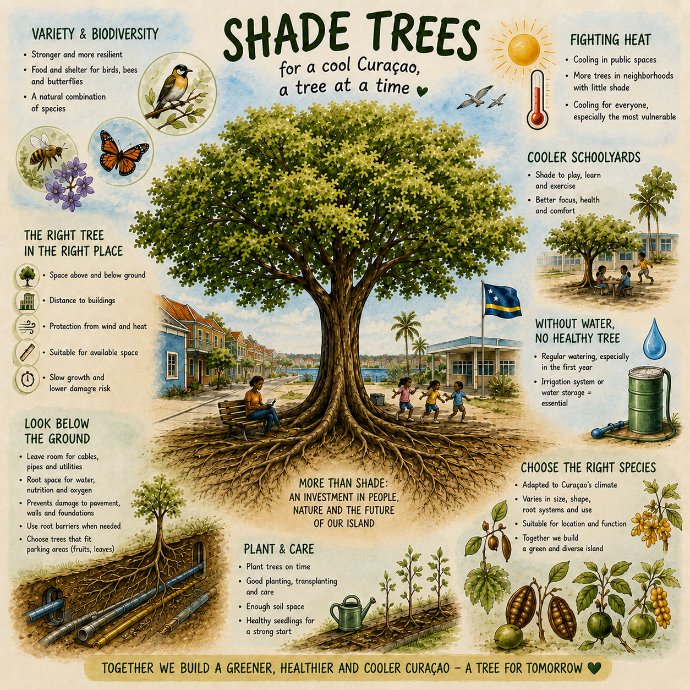
Working together on a cooler Curaçao
This series of articles has shown that shade trees are much more than decoration. They provide cooling, reduce heat stress, improve the quality of life in neighbourhoods and support nature in the city. Curaçao boasts an impressive collection of trees that are well adapted to the local climate. The challenge for the coming years is to use that wealth wisely. A cooler Curaçao does not arise overnight. It starts with a clear vision, good cooperation and the willingness to invest in a greener city with attention to the vulnerable groups. Tree by tree, street by street and neighborhood by neighborhood, we can build a greener, healthier and more attractive Curaçao, for today's residents and for the generations that come after us.