Four Shade Trees for a Cooler Curacao
(Published in the newspaper Amigoe on the 1st of July 2026)
In the previous articles we have looked at the increasing heat on Curaçao, the importance of shade trees, the way in which trees provide cooling and a number of special tree species that are excellent for our neighborhoods, city center and schools. Successively, we have paid attention to the watapana (divi divi), the sea grape, the wayaká, the watakeli and the mahok.
However, that is not the end of the story. Curaçao has a much greater wealth of native tree species. In addition to the native tree species, we also have tree species that are not native but that are established here and that are adapted to the climate. Some of these are less known to the general public, but can make an important contribution to cooling, biodiversity and an attractive streetscape. In this article, we look at some more shade trees. In the following, we will briefly discuss the mata piská, the indju, the ròmbeshi, and the kalbas.
Mata piská: a special tree from Curaçao's nature
The mata piská (Jacquinia armillaris) is a native tree that is well adapted to the dry conditions of Curaçao. The name refers to a traditional use of the plant. The branches contain substances that were used by fishermen to stun fish in the past. This made it easier to catch the fish. The tree grows slowly but is resistant to drought, wind, salty sea air and poor soils. The shiny, leathery leaves limit moisture loss and help the tree withstand long dry periods.
During flowering, small, white to cream-colored flowers appear that attract insects. The subsequent fruits provide food for various bird species, making the tree contribute to biodiversity. Although it does not grow into a large shade tree like the watapana or wayaká, its compact crown still provides a pleasant, filtered shade and can provide cooling in smaller places. Due to its modest size, its graceful growth habit and its low maintenance requirements, the mata piská is very suitable for parks, school gardens, roadsides and nature-friendly residential areas. The planting of this native species also contributes to the preservation of the original flora of Curaçao and makes urban planting more resistant to the effects of a warmer and drier climate.
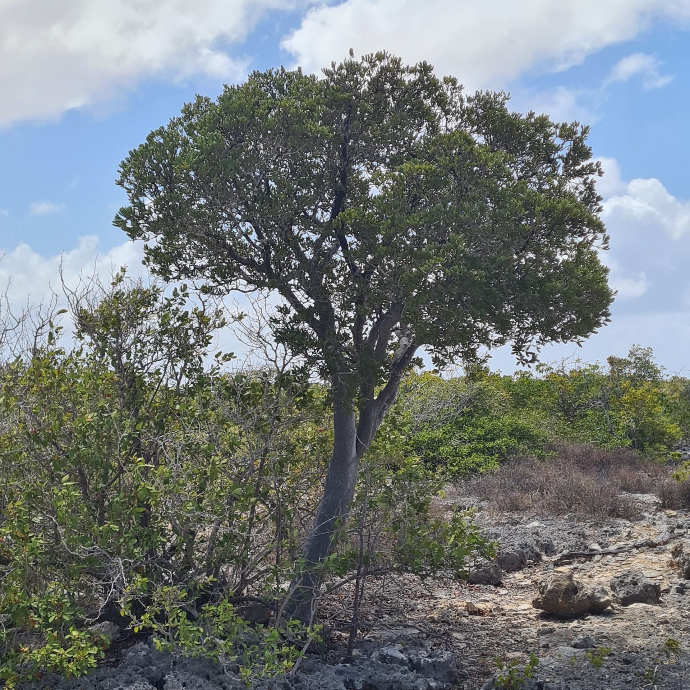 Mata piská (Photo: John de Freitas)
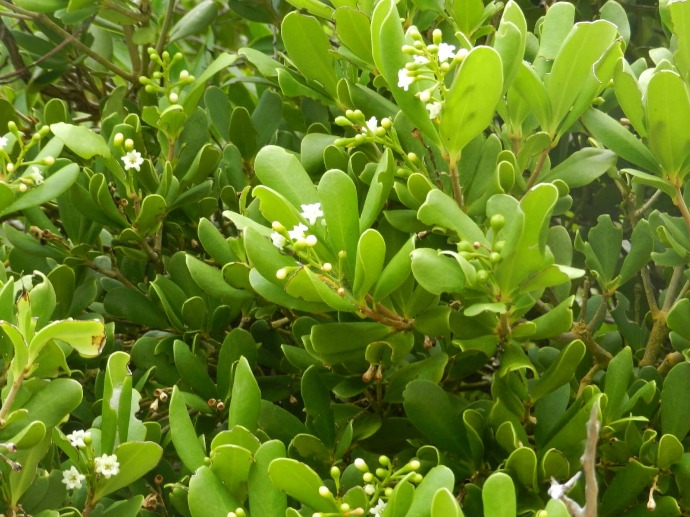
Flowers of the mata piská (Photo: R. te Hennepe)
Indju: specialist in drought and heat
The indju (Prosopis juliflora) is one of the most drought-tolerant tree species in Curaçao. Thanks to its very deep root system, this tree can survive prolonged dry periods. The tree grows relatively quickly and can develop a broad crown that provides significant shade. The younger trees in particular have thorns. Historically, the hard wood was widely used for making charcoal and for all kinds of practical applications. According to Brother Arnoldo in his book Cultivated and useful plants of the Netherlands Antilles (first edition 1954), beautiful decorative tables were made in Aruba from the wood of very old indju trees.
The legume pods are also a source of food for goats, donkeys and other livestock, which is why the tree traditionally played a role in livestock farming. The flowers provide nectar and pollen for bees and other pollinating insects. The indju is also resistant to heat, wind and salty sea air, properties that make it suitable for the dry coastal climate of Curaçao.
However, the tree does require a careful choice of location. The wide crown, deep root system and thorns make it less suitable for narrow streets, parking lots and playgrounds. The indju is especially suitable for larger green areas, buffer strips and recreational areas where sufficient space is available. However, under the right conditions, the indju can play an important role in the greening of warm and dry parts of the island.

Flowers and pod of the Indju (Foto: R. te Hennepe)
Ròmbeshi: sustainable shade for the long term
The ròmbeshi (Sideroxylum obovatum) is one of the original trees of the dry forests of Curaçao. It is an evergreen variety known for its durability and longevity. The leaves are leathery and spatula-shaped. The leathery leaves limit moisture loss and help the tree withstand long dry periods. The tree develops a sturdy trunk and a dense crown that provides pleasant shade at maturity.
In addition, the fruits produce food for birds and other animals. Precisely because the ròmbeshi is fully adapted to the local conditions, it requires relatively little maintenance after installation. For residential areas, larger school grounds and parks, this species can therefore be a valuable investment for the long term.

Ròmbeshi (Photo: Dolfi Debrot)
Kalbas: shade tree with a rich cultural history
The kalbas (Crescentia cujete) is one of the most characteristic trees in the Caribbean. On Curaçao, the tree has been part of yards, kunukus and village communities for generations. After drying, the large round fruits are traditionally used to make bowls, bowls, spoons, musical instruments and other utensils. The fruits can fall to the ground. This tree is therefore not suitable for parking spaces or where people walk under it.
The kalbas grows relatively slowly, but over time develops a broad, rounded crown that provides pleasant shade. The tree is well adapted to the dry climate of Curaçao and can withstand long periods of drought. Moreover, it requires little maintenance once it is well established.
It can lose all or part of its leaves in the dry season. However, this also depends on the location. Trees that are in a damp location or receive extra water can stay green much longer and sometimes almost always bear leaves. The fruits are also used in Curaçao to make the "stropi kalbas" which is said to help with throat irritations and colds.

Kalbas tree (Photo: Yaír Stokkermans)

Kalbas (Photo: R. te Hennepe)
In the next article, the last four trees in this series will be discussed. These are the oliba and its brother the palu pretu, the romangel and a green giant with sour fruits, the tamarind.
Four Shade Trees for a Cooler Curacao